
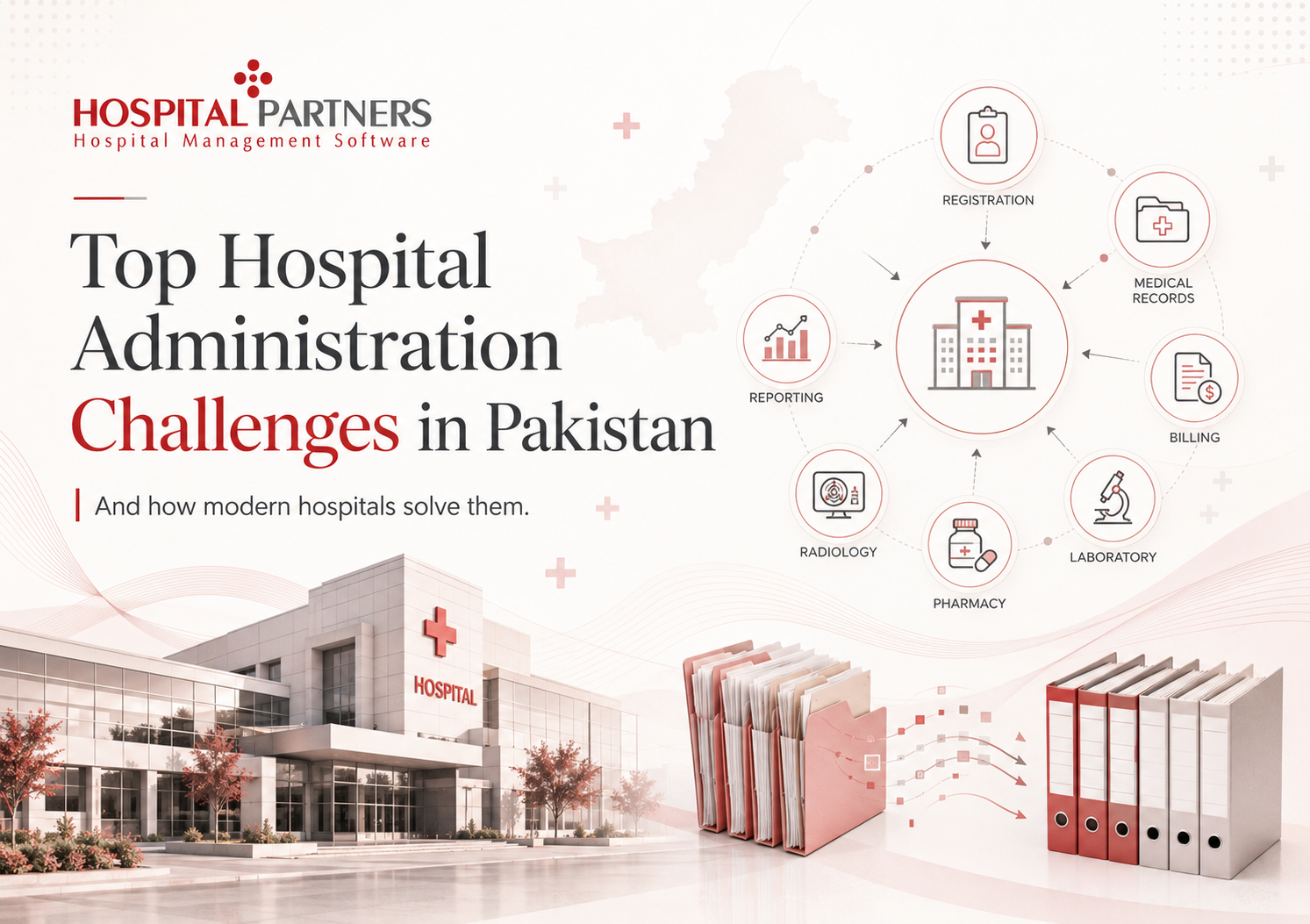
Managing a hospital has never been more demanding. Rising patient volumes, increasing operational costs, growing regulatory requirements, and higher expectations for quality care have made hospital administration challenges in Pakistan more complex than ever before. Hospital administrators are expected to improve patient outcomes while controlling costs, coordinating multiple departments, ensuring compliance, and maintaining efficient day-to-day operations.
Unfortunately, many hospitals still rely on paper records, disconnected software, or manual processes that slow down decision-making and increase the risk of errors. As healthcare demands continue to grow, these traditional approaches make it difficult to deliver consistent, high-quality patient care.
This guide explores the most significant hospital administration challenges facing healthcare providers in Pakistan, explains their impact on hospital performance, and discusses how modern digital healthcare technologies can help hospitals operate more efficiently.
Quick Answer: What Are the Biggest Hospital Administration Challenges in Pakistan?
The biggest hospital administration challenges in Pakistan include long patient waiting times, paper-based medical records, poor coordination between departments, billing inefficiencies, workforce scheduling issues, inventory management problems, diagnostic delays, limited operational visibility, compliance requirements, and rising healthcare costs. Modern Hospital Management Information Systems (HMIS) like Hospital.Partners helps address these challenges by integrating clinical, administrative, and financial processes into one centralized platform.
What Is Hospital Administration?
Hospital administration refers to the planning, coordination, and management of a hospital’s clinical, operational, financial, and administrative activities. It ensures that patients receive timely, safe, and high-quality care while the hospital operates efficiently and remains financially sustainable.
Hospital administrators oversee a wide range of responsibilities, including:
- Managing patient services
- Coordinating clinical departments
- Supervising hospital staff
- Monitoring budgets and operational costs
- Ensuring regulatory compliance
- Improving patient experience
- Supporting strategic planning and growth
In today’s healthcare environment, effective hospital administration is no longer just about managing people and paperwork. It requires real-time information, streamlined workflows, and technology that helps departments work together.
Why Hospital Administration Is Becoming More Challenging in Pakistan
Healthcare in Pakistan is evolving rapidly. Population growth, urbanization, and increasing awareness of quality healthcare have significantly increased patient demand. At the same time, hospitals face pressure to improve efficiency while controlling operational expenses.
Several factors contribute to these challenges:
- Growing patient volumes
- Shortage of skilled healthcare professionals
- Increasing healthcare costs
- More complex regulatory requirements
- Greater demand for digital healthcare services
- Expectations for faster and more personalized patient care
Hospitals that continue to depend on manual systems often struggle to keep pace with these changes. Information becomes fragmented, departments work in isolation, and administrators spend more time solving operational issues than planning for long-term improvements.
1. Long Patient Waiting Times
Patient waiting time remains one of the most common complaints in hospitals across Pakistan.
Delays often begin at registration and continue throughout the patient’s journey from consultation and diagnostics to pharmacy and billing. Long queues not only reduce patient satisfaction but also increase pressure on doctors, nurses, and administrative staff.
Common Causes
- Manual patient registration
- Walk-in appointment overload
- Poor queue management
- Limited visibility into doctor availability
- Delayed communication between departments
Operational Impact
Long waiting times can lead to:
- Reduced patient satisfaction
- Missed appointments
- Overcrowded waiting areas
- Lower staff productivity
- Increased administrative workload
How Technology Helps
Digital patient registration, appointment scheduling, and queue management systems help hospitals streamline patient flow, reduce registration delays, and improve coordination between departments. Real-time scheduling also allows administrators to optimize doctor availability and minimize bottlenecks.
2. Paper-Based Medical Records
Although many healthcare providers have adopted digital technologies, paper records remain common in numerous hospitals and clinics throughout Pakistan.
Paper files are difficult to organize, easy to misplace, and often require significant time to retrieve. When patient information is spread across multiple folders or departments, clinicians may not have access to a complete medical history when making treatment decisions.
Common Challenges
- Lost or misplaced files
- Duplicate patient records
- Slow record retrieval
- Handwriting interpretation issues
- Limited access during emergencies
- Difficult record sharing between departments
Operational Impact
Incomplete or inaccessible patient information can delay diagnosis, slow treatment decisions, and increase administrative effort. Staff often spend valuable time searching for records instead of focusing on patient care.
How Technology Helps
Electronic Medical Records (EMRs) centralize patient information in one secure location. Authorized healthcare professionals can quickly access consultation notes, laboratory results, medication history, radiology reports, and previous admissions, improving both efficiency and continuity of care.
3. Poor Coordination Between Hospital Departments
Hospitals operate through multiple specialized departments that must work together seamlessly.
A patient’s journey may involve registration, consultation, laboratory testing, radiology, pharmacy, billing, and inpatient care. When these departments rely on separate systems or manual communication, delays and errors become more likely.
Common Problems
- Duplicate data entry
- Delayed laboratory requests
- Missing diagnostic reports
- Miscommunication between departments
- Repeated patient information collection
- Slow discharge processes
Operational Impact
Poor coordination increases patient waiting times, creates unnecessary administrative work, and reduces overall hospital efficiency. Staff spend more time exchanging information manually instead of focusing on patient care.
How Technology Helps
Integrated Hospital Management Information Systems (HMIS) allow departments to share information in real time. Patient records, laboratory requests, pharmacy orders, billing information, and clinical updates remain synchronized, reducing communication gaps and improving operational efficiency.
4. Billing Errors and Revenue Leakage
Hospital billing involves much more than generating invoices. Charges must accurately reflect consultations, laboratory tests, radiology services, pharmacy transactions, inpatient stays, procedures, and other services provided during a patient’s visit.
When billing processes are handled manually or across disconnected systems, hospitals face a higher risk of financial inaccuracies.
Common Causes
- Missed billable services
- Duplicate charges
- Manual calculation errors
- Delayed invoice generation
- Poor coordination between clinical and billing departments
- Difficulty tracking outstanding payments
Operational Impact
Billing errors not only affect hospital revenue but also create disputes with patients and insurers. Delayed collections can impact cash flow, while inaccurate financial reporting makes strategic planning more difficult.
How Technology Helps
An integrated hospital management system automatically captures billable services as they occur, reducing manual data entry and improving billing accuracy. Centralized financial reporting also gives hospital administrators better visibility into revenue, outstanding receivables, and operational performance.
5. Staff Scheduling and Workforce Management
Hospitals depend on the availability of doctors, nurses, technicians, pharmacists, administrative staff, and support teams. When staffing is not planned properly, patient care and hospital efficiency both suffer.
In many hospitals, workforce planning is still managed through manual rosters, phone calls, paper duty charts, or spreadsheets. This creates problems when staff are absent, shifts change, or patient volume suddenly increases.
Common Problems
- Unplanned staff shortages
- Manual duty rosters
- Overtime miscalculations
- Poor visibility of doctor availability
- Nurse scheduling gaps
- Difficulty managing leave and replacement staff
- Lack of real-time attendance information
Operational Impact
Poor workforce management can lead to longer patient waiting times, overworked staff, higher overtime costs, and reduced service quality. It also makes it difficult for administrators to plan staffing according to actual patient demand.
How Technology Helps
Digital workforce and attendance management tools help hospitals track staff availability, manage shifts, monitor overtime, and connect attendance data with payroll. Administrators can make better staffing decisions when they have real-time visibility into duty rosters, absences, and department needs.
6. Pharmacy and Inventory Management Challenges
Hospital pharmacies and medical stores deal with sensitive inventory. Medicines, surgical items, consumables, emergency stock, and high-value supplies must be available when needed.
Manual inventory tracking can create serious operational problems.
Common Problems
- Medicine stock-outs
- Overstocking of slow-moving items
- Expired medicines
- Manual stock reconciliation
- Poor batch and expiry tracking
- Unclear consumption patterns
- Delayed purchase requests
- Weak coordination between pharmacy and billing
Operational Impact
Inventory problems affect both patient care and hospital finances. Stock-outs may delay treatment, while overstocking ties up cash. Expired medicines create waste and compliance risk. Manual reconciliation also increases the chance of errors and stock leakage.
How Technology Helps
A digital pharmacy and inventory management system helps hospitals track stock levels, batch numbers, expiry dates, purchases, consumption, and billing integration. When pharmacy is connected with patient prescriptions and billing, hospitals gain better control over medicine dispensing and revenue capture.
7. Laboratory and Diagnostic Delays
Laboratory and diagnostic services are central to patient care. Doctors often depend on lab results, radiology reports, and diagnostic findings before making treatment decisions.
When diagnostic workflows are manual, delays become common.
Common Problems
- Lost test requests
- Manual sample tracking
- Delayed result entry
- Duplicate testing
- Missing reports
- Poor communication between lab and doctors
- Slow radiology reporting
- Billing mismatch for diagnostic services
Operational Impact
Diagnostic delays slow down treatment, increase patient waiting time, and reduce doctor productivity. In inpatient care, delayed results may also extend hospital stays and increase costs for both the patient and the hospital.
How Technology Helps
Laboratory and radiology integration helps hospitals send test requests digitally, track sample status, record results, attach reports to patient records, and connect diagnostic services with billing. This improves turnaround time and gives doctors faster access to important clinical information.
8. Limited Operational Visibility
Hospital administrators need accurate information to make daily and strategic decisions. Unfortunately, many hospitals do not have a real-time view of operations.
When data is spread across different departments, administrators may struggle to answer basic questions quickly.
Common Questions Administrators Need to Answer
- How many patients visited OPD today?
- How many beds are occupied?
- Which departments are overloaded?
- What is today’s revenue?
- Which bills are pending?
- Which lab reports are delayed?
- Which medicines are low in stock?
- How many patients are waiting?
- Which doctors have the highest appointment load?
Operational Impact
Without real-time reporting, decisions are based on assumptions instead of data. Management may discover problems only after they have already affected patient care, revenue, or staff performance.
How Technology Helps
Hospital dashboards and reporting tools give administrators a centralized view of patient flow, billing, department performance, pharmacy stock, diagnostics, admissions, and revenue. Real-time visibility helps leadership respond faster and plan better.
9. Compliance and Patient Data Security
Hospitals manage sensitive patient information, including medical history, diagnoses, prescriptions, lab results, radiology reports, billing details, and personal data.
If this information is not properly secured, hospitals face privacy, trust, and operational risks.
Common Problems
- Uncontrolled access to patient files
- Paper records viewed by unauthorized people
- Missing audit trails
- Weak password practices
- No clear user permissions
- Poor backup planning
- Difficulty tracking changes in records
Operational Impact
Poor data security can damage patient trust and create legal or reputational risks. It also makes it difficult to investigate disputes, verify actions, or maintain proper administrative control.
How Technology Helps
A secure HMIS supports role-based access, user permissions, audit logs, backups, and controlled record access. This ensures that only authorized users can view or update sensitive patient information.
Digital systems also help hospitals maintain better documentation for audits, reviews, and internal governance.
10. Rising Operational Costs
Hospital costs continue to rise due to staff requirements, medical supplies, utilities, equipment maintenance, technology needs, and administrative overhead.
Many cost increases are visible. Others are hidden inside inefficient workflows.
Hidden Cost Drivers
- Repeated data entry
- Paper record storage
- Manual billing corrections
- Duplicate lab tests
- Inventory wastage
- Delayed discharge processing
- Missed charges
- Staff overtime
- Poor department coordination
- Long patient waiting times
Operational Impact
Even small inefficiencies can become expensive when repeated across hundreds or thousands of patient visits. Hospitals may lose revenue, waste resources, and overburden staff without realizing the full financial impact.
How Technology Helps
Hospital automation helps reduce repetitive tasks, improve charge capture, control inventory, speed up billing, and provide better financial reporting. Administrators can identify cost leakage earlier and make more informed operational decisions.
Real-World Scenario: A Mid-Sized Hospital Facing Daily Bottlenecks
Consider a 100-bed hospital in Pakistan with busy OPD services, inpatient wards, laboratory, pharmacy, radiology, and billing departments.
The hospital uses separate systems for registration, pharmacy, and accounts, while patient records are mostly paper-based.
Every day, staff face familiar problems:
- Patients wait too long at registration.
- Doctors cannot always access old reports.
- Lab requests are sometimes misplaced.
- Pharmacy stock is checked manually.
- Billing staff wait for service confirmations.
- Administrators receive reports after delays.
- Discharge processing takes longer than expected.
No single department is fully responsible for the problem. The issue is that the workflow is disconnected.
After moving toward an integrated hospital management system, the hospital can connect patient registration, OPD, IPD, billing, laboratory, pharmacy, radiology, and reporting. Patient information becomes easier to access, services are billed more accurately, and management gets better visibility into daily operations.
The lesson is simple: hospital administration improves when departments stop working in isolation.
How Modern Hospital Management Software Solves These Challenges
A modern Hospital Management Information System brings clinical, financial, and administrative workflows into one connected platform.
Instead of managing each department separately, hospitals can connect the full patient journey from registration to discharge.
Key Areas Modern HMIS Supports
- Patient registration
- Appointment scheduling
- OPD management
- IPD management
- Electronic Medical Records
- Billing and invoicing
- Laboratory management
- Pharmacy management
- Radiology management
- Inventory control
- Queue management
- Reporting and dashboards
- User access control
- Financial visibility
When these modules work together, hospitals can reduce repeated data entry, improve communication, and make patient care more coordinated.
A hospital management system should not simply digitize old paperwork. It should help hospitals redesign workflows so that information moves faster and more accurately between departments.
How Hospital.Partners by Softronic Systems Supports Modern Hospital Administration
Hospital.Partners is designed to support hospitals and clinics through connected HMIS workflows. It brings patient, clinical, diagnostic, pharmacy, billing, and reporting processes into one structured environment.
Instead of treating each department as a separate unit, Hospital.Partners helps hospitals manage the patient journey more smoothly.
Hospital.Partners Supports
- Patient Registration
- Patient History
- OPD Management
- IPD Management
- EMR
- Billing
- Laboratory
- Pharmacy
- Radiology
- Inventory
- Reporting
For hospital administrators, this means better control over daily operations. For doctors, it means easier access to patient information. For billing teams, it means fewer missed services and more accurate invoicing. For management, it means stronger visibility into performance, revenue, and department activity.
Hospital.Partners should be viewed not only as software, but as a framework for improving hospital workflow, accountability, and operational efficiency.
Best Practices for Hospital Administrators
Hospital technology works best when it is supported by strong management practices.
Hospital administrators should:
- Standardize registration, billing, and discharge workflows.
- Digitize patient records gradually but consistently.
- Monitor key hospital KPIs such as OPD volume, occupancy, revenue, waiting time, lab turnaround, and pharmacy stock.
- Train staff before and after system implementation.
- Define clear roles and access permissions.
- Improve communication between OPD, IPD, lab, pharmacy, radiology, and billing.
- Review reports regularly instead of waiting for monthly summaries.
- Reduce duplicate data entry wherever possible.
- Plan inventory based on actual consumption.
- Choose software based on workflow fit, not only price.
- Keep backup and data security policies updated.
- Treat digital transformation as an operational improvement project, not only an IT project.
FAQS
1. What are the biggest hospital administration challenges in Pakistan?
The biggest hospital administration challenges in Pakistan include long patient waiting times, paper-based medical records, poor department coordination, billing errors, staff scheduling issues, pharmacy inventory problems, diagnostic delays, limited reporting, data security concerns, and rising operational costs.
2. How can hospitals reduce patient waiting time?
Hospitals can reduce patient waiting time by using digital registration, appointment scheduling, queue management, faster billing workflows, and better coordination between doctors, laboratory, pharmacy, and radiology departments.
3. Why are paper-based medical records a problem?
Paper-based medical records are difficult to store, retrieve, update, and share. They can be misplaced, duplicated, damaged, or delayed, which affects clinical decisions and increases administrative workload.
4. How does HMIS improve hospital administration?
An HMIS improves hospital administration by connecting patient registration, OPD, IPD, EMR, billing, laboratory, pharmacy, radiology, inventory, and reporting into one system. This improves visibility, reduces manual work, and supports better decision-making.
5. How can hospitals reduce billing errors?
Hospitals can reduce billing errors by connecting clinical services with billing. When consultations, lab tests, radiology services, medicines, procedures, and inpatient charges are captured digitally, the risk of missed or duplicate charges is reduced.
6. Why is department coordination important in hospitals?
Department coordination is important because patient care often involves multiple teams. OPD, IPD, laboratory, pharmacy, radiology, billing, and nursing staff must share accurate information to avoid delays and repeated work.
7. How can hospitals control operational costs?
Hospitals can control operational costs by reducing paper work, preventing duplicate data entry, improving inventory control, minimizing billing leakage, monitoring staff overtime, and using reports to identify inefficiencies.
Conclusion
Hospital administration in Pakistan is becoming more complex as patient volumes increase, healthcare costs rise, and expectations for faster, safer, and more organized care continue to grow.
The main challenges are not isolated. Long waiting times, paper records, billing errors, diagnostic delays, inventory issues, workforce problems, and poor reporting are often connected. When departments work separately, small problems spread across the whole hospital workflow.
Modern hospital administration requires more than manual effort. It requires connected information, standardized processes, trained teams, secure data, and real-time visibility.
A Hospital Management Information System like Hospital.Partners helps hospitals move from fragmented operations to integrated workflows. It supports better patient registration, faster access to records, accurate billing, improved laboratory and pharmacy coordination, stronger reporting, and better management control.
Hospital.Partners supports this shift by bringing core hospital operations into one connected HMIS environment, including patient registration, EMR, OPD, IPD, billing, laboratory, pharmacy, radiology, inventory, and reporting.
For hospital administrators, the goal is not only to adopt software. The goal is to build a hospital environment where staff can work more efficiently, patients receive smoother care, and leadership can make decisions based on reliable information.
If your hospital is struggling with manual records, billing delays, disconnected departments, or limited visibility, now is the right time to evaluate a digital hospital management system that can support long-term operational improvement.
Request a Hospital.Partners demo to see how integrated HMIS workflows can help your hospital improve administration, patient flow, billing accuracy, and operational visibility.