
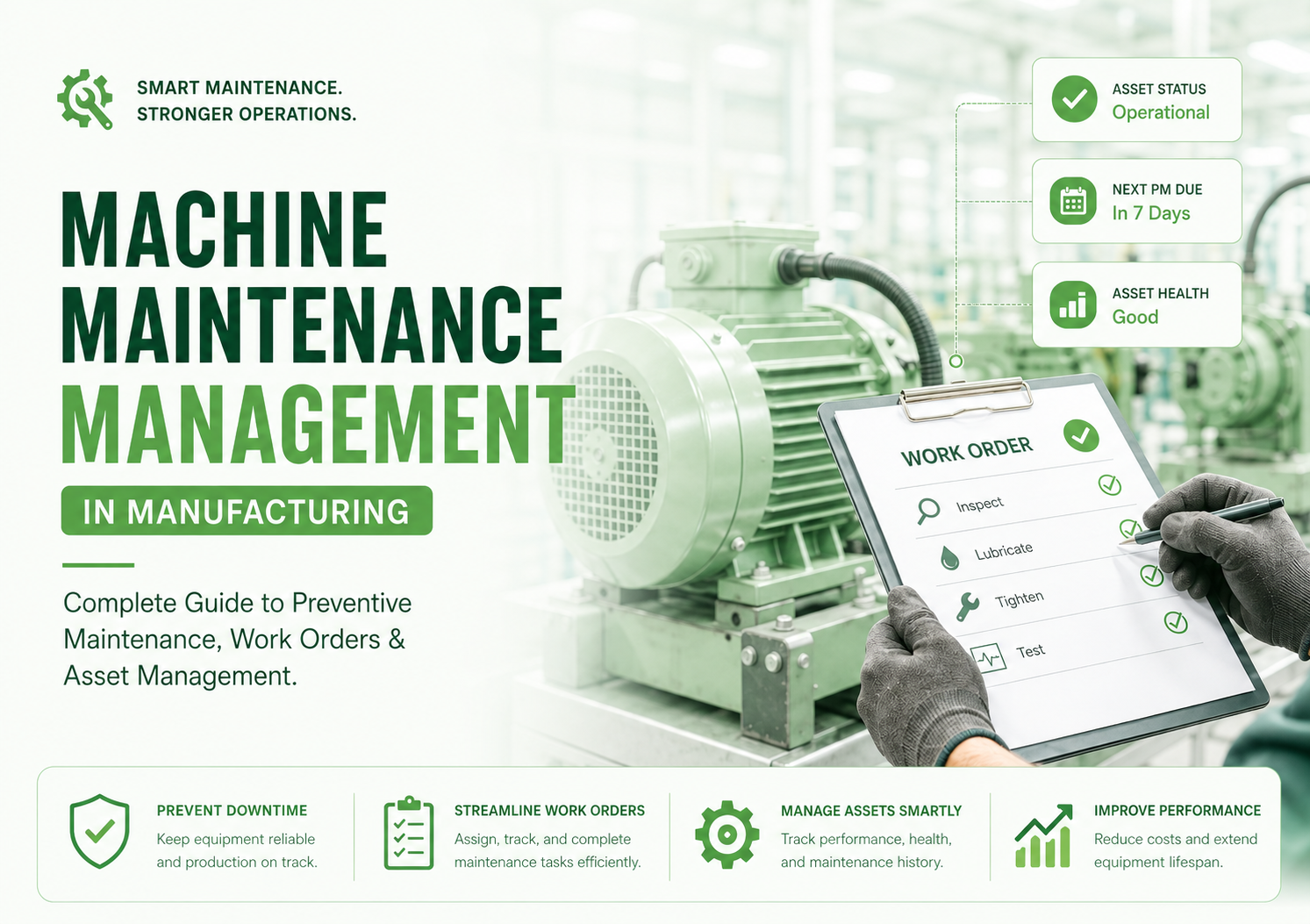
Manufacturing equipment plays a critical role in maintaining production continuity. When machines require repair, parts replacement, servicing, or preventive maintenance, businesses need a structured process to ensure that maintenance activities are properly requested, approved, scheduled, executed, and closed. Machine maintenance management provides manufacturers with a systematic way to manage these activities instead of relying on informal communication, spreadsheets, paperwork, or untracked maintenance requests.
For businesses managing multiple machines and maintenance requirements, an effective maintenance process can help improve visibility, organize repair work, support preventive maintenance, and provide better control over maintenance activities.
Financials.Partners includes a dedicated Machine Maintenance Management module designed to support this process through service requisitions, electronic approvals, work orders, completion acknowledgments, and scheduled maintenance.
What Is Machine Maintenance Management?
Machine maintenance management is the process of organizing and controlling maintenance activities related to plant machinery and equipment.
It typically involves four important stages:
Maintenance Request → Approval → Work Order → Completion
A structured system helps ensure that a maintenance requirement does not get lost between the department requesting the work and the team responsible for completing it.
For manufacturing businesses, this can be particularly useful when maintenance requirements involve:
- Machine repairs
- Parts replacement
- Engineering work
- Preventive maintenance
- Scheduled servicing
- Recurring equipment maintenance
Why Structured Machine Maintenance Matters
In a manufacturing environment, maintenance requests can originate from production, engineering, operations, or other departments.
Without a defined workflow, organizations may face problems such as:
- Delayed maintenance requests
- Unclear approval responsibilities
- Difficulty tracking repair work
- Missed preventive maintenance schedules
- Incomplete maintenance records
- Difficulty confirming whether work has been completed
- Poor visibility into upcoming maintenance requirements
A structured maintenance management process creates accountability at each stage.
Instead of:
“The machine needs repair.”
the organization can establish a defined workflow:
Request → Approval → Work Order → Maintenance Activity → Completion Acknowledgment
Key Features of Machine Maintenance Management in Financials.Partners
Financials.Partners provides specific functionality for managing machine maintenance activities.
1. Service & Engineering Work Requisitions
Maintenance requirements can begin with a service or engineering work requisition.
A department can raise a requirement when a machine requires:
- Repair
- Engineering attention
- Parts replacement
- Preventive maintenance
- Other maintenance-related work
The requisition can then move through an electronic approval process.
Why electronic approvals matter
Instead of depending entirely on physical paperwork or informal communication, electronic approvals provide a more structured way to authorize maintenance requirements.
This can help organizations establish:
- Clear responsibility
- Approval visibility
- Better request tracking
- More organized maintenance workflows
2. Work Order Generation
Once a maintenance requirement has been approved, a work order can be generated.
Financials.Partners supports work order generation for:
- Repair
- Parts replacement
- Preventive maintenance
This is important because a maintenance request and a maintenance job are not necessarily the same thing.
A requisition identifies the requirement.
A work order turns that requirement into an actionable maintenance job.
Example
A production department notices that a machine is not operating correctly.
The process can be:
Machine Issue
↓
Service / Engineering Requisition
↓
Electronic Approval
↓
Work Order
↓
Repair / Parts Replacement
↓
Completion Acknowledgment
This creates a more controlled maintenance workflow.
3. Completion Acknowledgment for Closed Maintenance Jobs
Completing a maintenance job is not necessarily the same as confirming that the work has been satisfactorily completed.
Financials.Partners includes completion acknowledgment by the requester for closed maintenance jobs.
This provides an additional confirmation step in the maintenance process.
The workflow can therefore move from:
Maintenance Request
to
Approved Work Order
to
Completed Maintenance Job
to
Requester Acknowledgment
This helps establish a clearer record that the requested maintenance activity has been completed and acknowledged by the requesting party.
4. Monthly & Yearly Maintenance Scheduling
Reactive maintenance is only one part of equipment management.
Manufacturers also need to plan maintenance activities before problems occur.
Financials.Partners supports monthly and yearly maintenance scheduling for proactive asset management.
This can help businesses organize recurring maintenance requirements instead of relying solely on breakdown-based maintenance.
For example:
A machine may require scheduled maintenance every month.
Rather than waiting for someone to remember the maintenance requirement, the organization can plan the activity as part of its maintenance schedule.
For larger manufacturing environments, yearly planning can also provide greater visibility into upcoming maintenance requirements.
Preventive Maintenance Vs Breakdown Maintenance
One of the biggest differences between reactive and proactive maintenance is when the organization takes action.
Breakdown maintenance
Machine fails → Maintenance request → Repair → Machine returns to operation
Preventive maintenance
Maintenance schedule → Planned work → Preventive maintenance → Reduced risk of unexpected failure
Neither approach completely eliminates equipment problems.
However, scheduled preventive maintenance gives organizations a way to plan maintenance activities rather than relying exclusively on unexpected breakdowns.
How a Machine Maintenance Workflow Works
A structured maintenance process can be represented as:
Step 1: Identify the Requirement
A department identifies a machine or engineering requirement.
Step 2: Create a Requisition
A service or engineering work requisition is raised.
Step 3: Obtain Approval
The requisition moves through the electronic approval process.
Step 4: Generate a Work Order
An approved requirement is converted into a maintenance work order.
Step 5: Perform the Maintenance
The required repair, parts replacement, or preventive maintenance activity is performed.
Step 6: Close the Job
Once the work is completed, the maintenance job is closed.
Step 7: Obtain Completion Acknowledgment
The requester acknowledges completion of the maintenance job.
Step 8: Schedule Future Maintenance
Where applicable, monthly or yearly maintenance schedules can be maintained for proactive asset management.
How Maintenance Scheduling Supports Proactive Asset Management
Maintenance becomes significantly more manageable when organizations know what needs to be maintained and when.
Monthly and yearly maintenance scheduling can help businesses plan ahead for recurring maintenance requirements.
Instead of asking:
“Which machine has a problem today?”
management can also ask:
“Which machines require maintenance this month?”
and:
“What maintenance activities are planned for the coming year?”
This shift from purely reactive maintenance toward planned maintenance can improve organizational visibility and help maintenance teams prepare for upcoming work.
Why Work Orders Are Important in Manufacturing
A maintenance work order creates a formal reference for a particular maintenance job.
For example:
Machine: Production Machine A
Requirement: Parts Replacement
Work Type: Repair
Approval: Completed
Work Order: Generated
Maintenance: Completed
Requester: Acknowledged
This creates a clearer workflow than relying on verbal instructions or informal messages.
Work orders can also help organizations distinguish between different types of maintenance activities, such as:
- Repair work
- Parts replacement
- Preventive maintenance
Electronic Approvals Make Maintenance More Accountable
Maintenance requirements often involve resources, engineering effort, and operational disruption.
An electronic approval process helps establish a defined authorization workflow.
For example:
Department raises request
↓
Authorized person reviews request
↓
Request approved
↓
Work order generated
This provides greater structure than a maintenance process based entirely on emails, paper forms, phone calls, or verbal instructions.
Machine Maintenance Management for Manufacturing Businesses
Manufacturers managing multiple production machines can benefit particularly from a structured maintenance process.
Consider a factory with:
- Multiple production machines
- Different maintenance schedules
- Regular parts replacement requirements
- Preventive maintenance activities
- Engineering service requests
- Multiple departments raising maintenance requirements
As the number of machines increases, informal maintenance management becomes increasingly difficult.
A centralized process can provide a clearer way to manage:
Requests + Approvals + Work Orders + Completion + Scheduling
Machine Maintenance Management Checklist
When evaluating a machine maintenance management system, manufacturers should consider whether it supports:
Maintenance Requests
- Service requisitions
- Engineering work requisitions
- Structured maintenance requests
Approval
- Electronic approval workflow
- Defined authorization process
Work Management
- Work order generation
- Repair work orders
- Parts replacement work orders
- Preventive maintenance work orders
Completion
- Maintenance job closure
- Requester completion acknowledgment
Maintenance Planning
- Monthly maintenance scheduling
- Yearly maintenance scheduling
- Proactive asset management
These capabilities provide the foundation for a more structured machine maintenance process.
How Financials.Partners Manages Machine Maintenance
Financials.Partners includes a dedicated Machine Maintenance Management module designed to organize maintenance requirements through a defined workflow.
The module supports:
Service & Engineering Work Requisitions
Maintenance and engineering requirements can be raised through requisitions with electronic approvals.
Work Order Generation
Approved requirements can generate work orders for repair, parts replacement, and preventive maintenance.
Completion Acknowledgment
The requester can acknowledge completion when maintenance jobs are closed.
Monthly & Yearly Maintenance Scheduling
Maintenance activities can be scheduled on a monthly and yearly basis to support proactive asset management.
Together, these capabilities create a structured maintenance workflow:
Requisition → Electronic Approval → Work Order → Maintenance → Completion Acknowledgment → Scheduled Follow-up
This approach helps manufacturers move away from purely reactive maintenance toward a more organized maintenance management process.
Conclusion
Effective machine maintenance is not simply about repairing equipment after it breaks.
A well-organized maintenance process should provide a clear path from:
- Maintenance Requirement
- Electronic Approval
- Work Order
- Repair / Parts Replacement / Preventive Maintenance
- Completion Acknowledgment
- Monthly & Yearly Maintenance Scheduling
For manufacturing businesses, this structured approach can make maintenance activities easier to organize, track, approve, and plan.
Financials.Partners brings these machine maintenance capabilities into its broader ERP environment, giving manufacturing businesses a dedicated system for managing service requisitions, work orders, maintenance completion, and proactive maintenance scheduling.