
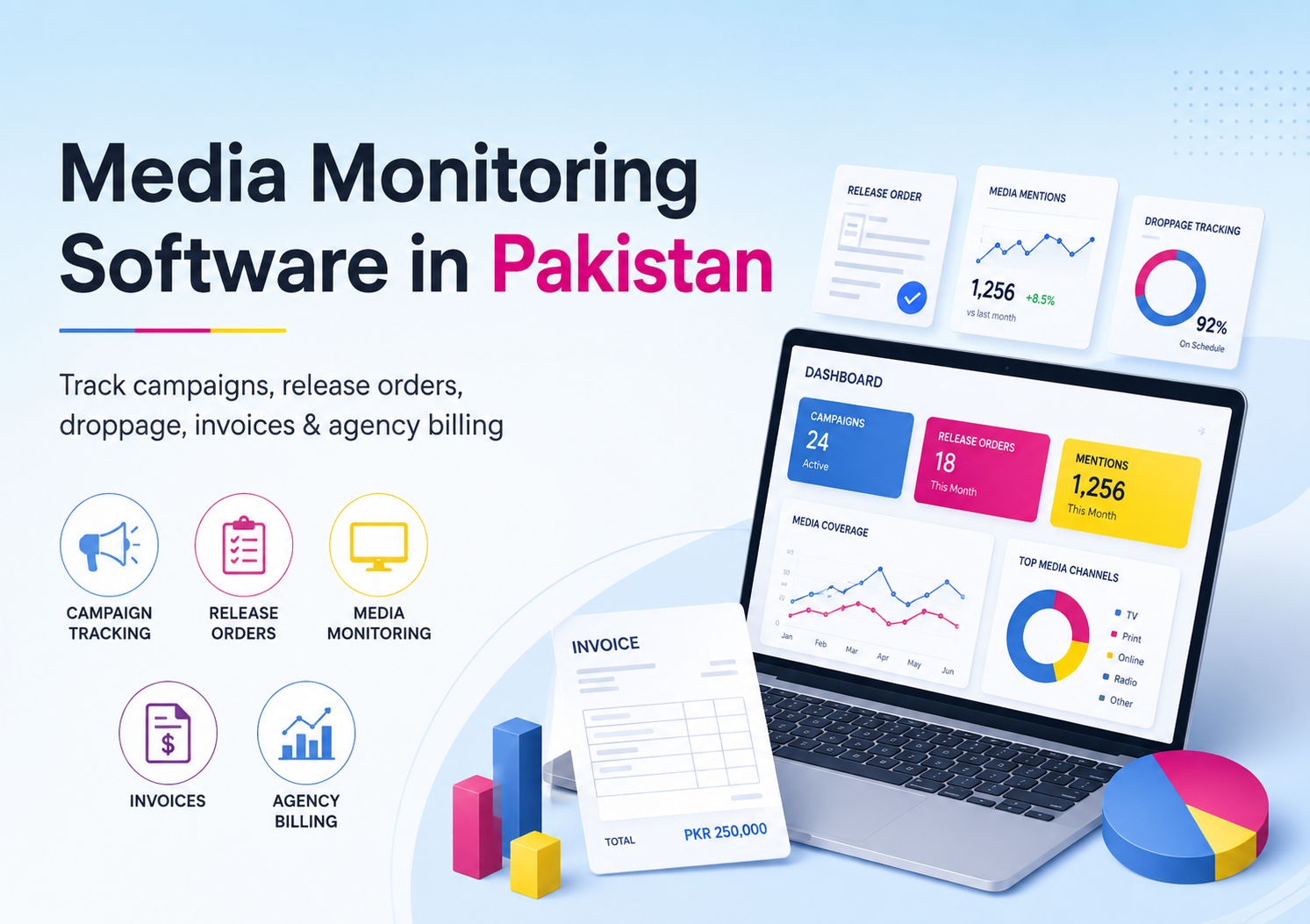
Media monitoring software in Pakistan is becoming essential for advertising agencies, media buying houses, creative agencies, and marketing teams that need better control over campaign execution, release orders, droppage, billing, vendor payments, and client reporting.
In advertising, the work does not end when a campaign is approved. Agencies still need to track whether ads were released, whether media placements were delivered correctly, whether droppage occurred, whether invoices match actual execution, and whether vendor bills are properly recorded.
When these processes are handled manually, agencies lose time, miss billing opportunities, delay client invoices, and struggle to connect media activity with financial accounts.
That is where a structured platform like Advertising.Partners becomes valuable. It supports advertising business workflows such as job orders, estimates, release order management, media monitoring, droppage, invoicing, vendor bills, payments, and financial accounts in one connected environment.
What Is Media Monitoring Software?
Media monitoring software helps advertising agencies track campaign execution across media activities, verify whether planned placements were delivered, identify droppage, connect monitoring data with invoices, and improve reporting for clients and management.
For advertising agencies, media monitoring is not only about tracking ads. It is also about protecting revenue, improving billing accuracy, managing client approvals, and keeping agency operations financially controlled.
Why Advertising Agencies in Pakistan Need Media Monitoring Software
Advertising agencies in Pakistan often manage multiple clients, campaigns, vendors, media types, estimates, release orders, invoices, and payment cycles at the same time.
A single campaign may involve:
- Client brief
- Job order
- Estimate
- Internal approval
- Client approval
- Release order
- Media execution
- Monitoring
- Droppage tracking
- Client invoice
- Vendor bill
- Payment voucher
- Receivable and payable reporting
If these steps are handled through Excel, emails, paper approvals, and disconnected accounting systems, errors become common.
Common agency problems include:
- Missing campaign execution proof
- Delayed invoices
- Unclear droppage records
- Manual release order tracking
- Vendor bills not matched with campaign data
- Client billing disputes
- Slow approval cycles
- Weak receivable and payable visibility
- Poor cost and revenue reporting
- No single view of job order status
Media monitoring software helps agencies move from scattered tracking to structured campaign control.
Media Monitoring vs General Social Listening
Many people confuse media monitoring with social listening. They are related, but not the same.
| Area | Media Monitoring for Agencies | Social Listening |
| Main focus | Campaign placement, execution, RO, droppage, billing | Brand mentions, sentiment, conversations |
| Main users | Advertising agencies, media buyers, finance teams | PR teams, social media teams |
| Business impact | Billing accuracy, campaign verification, client reporting | Brand reputation and audience insight |
| Financial link | Strong connection with invoices and vendor bills | Usually indirect |
| Best for | Media campaign control | Public conversation analysis |
For Advertising.Partners, the strongest SEO angle is media monitoring for advertising agency operations, not general PR monitoring.
Core Problems Solved by Media Monitoring Software
1. Campaign Execution Becomes Trackable
Without a system, agencies may know that a campaign was planned, but not have a clean record of what was actually executed.
A media monitoring system helps agencies track campaign activity against approved estimates and release orders.
2. Droppage Becomes Visible
Droppage happens when planned media activity is not fully delivered or released as expected.
If droppage is not tracked properly, agencies may:
- Invoice incorrectly
- Pay vendors incorrectly
- Miss client adjustments
- Lose trust during reconciliation
- Spend hours manually checking records
Advertising.Partners includes droppage as part of its advertising business workflow.
3. Invoicing Becomes More Accurate
Media monitoring data can support invoice generation, especially when invoices must reflect actual execution and droppage.
Advertising.Partners supports automatic generation of invoices based on media monitoring data, including droppage where applicable.
4. Vendor Bills Are Easier to Manage
Advertising agencies usually work with multiple vendors, media suppliers, production houses, printers, channels, publications, and service providers.
A proper system helps agencies record supplier bills and generate payment vouchers in financial accounts.
5. Client Reporting Improves
Clients expect agencies to explain:
- What was approved?
- What was released?
- What was monitored?
- What was dropped?
- What was billed?
- What is pending?
A connected media monitoring system makes these answers easier to provide.
How Media Monitoring Fits into the Advertising Agency Workflow
Media monitoring should not work alone. It should connect with the complete advertising workflow.
Step 1: Job Order Creation
The process begins with a job order.
Advertising.Partners supports job order management for different advertising work types, including audio visual, artwork, electronic, press, production, events, and others.
Each job order can carry important information such as client, product, job title, media details, delivery date, cost, quantity, deadlines, and other campaign-specific details.
Step 2: Internal Approval
Before a job moves forward, it should pass through an approval process.
Advertising.Partners supports electronic approval with electronic signature according to a predefined workflow before a job order moves to the estimate stage.
Step 3: Estimate Preparation
After the approved job order, the agency prepares an estimate.
The system can prepare estimates against approved job orders using information such as client, month, purchase order number, supplier, description, quantity, rate, agency service charges, sales tax, and instructions.
Step 4: Client Approval
Once an estimate is approved internally, it can be sent to the client for approval. The client’s approval date can also be recorded against the estimate.
Step 5: Release Order Management
After client approval, the release order is prepared.
Advertising.Partners supports release orders based on approved estimates and allows attachments such as PDF, images, voice files, and video files. Release orders also require electronic approval before being sent to the customer.
Step 6: Media Monitoring
Media monitoring tracks whether the approved media activity was actually executed.
This is where the agency confirms campaign delivery, identifies droppage, and prepares billing based on actual activity.
Step 7: Invoicing and Financial Posting
After media monitoring, invoices can be generated and posted into financial accounts.
Advertising.Partners supports invoice posting with automatic voucher generation in financial accounts.
This is the real power of an integrated advertising agency software system: campaign operations and financial accounting stay connected.
Key Features to Look for in Media Monitoring Software in Pakistan
1. Job Order Integration
Media monitoring should connect with job orders. This ensures every campaign activity has a traceable starting point.
2. Estimate and Approval Workflow
The system should connect estimates with job orders and approval workflows so that only approved campaigns move forward.
3. Release Order Management
A good media monitoring system should support release orders, attachments, approval status, and campaign execution tracking.
4. Droppage Tracking
Droppage tracking is critical for advertising agencies because it affects client billing and vendor payments.
5. Invoice Automation
Media monitoring should support invoice generation based on actual media execution.
6. Vendor Bill Management
The system should track supplier bills and connect them with financial accounts.
7. Receivable and Payable Reports
Agencies need visibility into client receivables and supplier payables.
Advertising.Partners includes reports such as supplier statements, supplier ledgers, payable summaries, receivable summaries, client ledgers, client aging, supplier aging, and payment receipts.
8. Dashboard and Alerts
A strong system should give management a quick view of agency performance.
Advertising.Partners includes dashboard areas such as job-origin share, top customer revenue share, and revenue versus expense comparison. It also includes alerts for pending estimates, outstanding invoices, bills to be paid, and current receivables/payables.
Manual Media Monitoring vs Digital Media Monitoring
| Area | Manual Process | Media Monitoring Software |
| Campaign tracking | Excel, email, and staff follow-up | Centralized campaign records |
| Job order link | Often disconnected | Linked with job request |
| Estimate status | Manually checked | Trackable approval workflow |
| Release order | Paper/email based | Digital RO management |
| Droppage | Easy to miss | Recorded and visible |
| Invoice creation | Manual calculation | Based on monitored data |
| Vendor bills | Separate accounting process | Connected with financial accounts |
| Reports | Time-consuming | Available from system data |
| Alerts | Depends on memory | System-based alerts |
| Management visibility | Limited | Dashboard driven |
Manual tracking may work for a small agency, but it becomes risky when client volume, media activity, vendors, and billing complexity increase.
Benefits of Media Monitoring Software for Advertising Agencies
Better Billing Accuracy
When invoices are based on monitored campaign data, agencies reduce the risk of overbilling, underbilling, or missing billable activity.
Faster Client Invoicing
Automated invoice generation helps finance teams avoid delays after campaign execution.
Stronger Droppage Control
Droppage becomes easier to identify, explain, and adjust.
Better Vendor Payment Control
Supplier bills and payment vouchers can be connected with financial accounts, reducing manual reconciliation.
Improved Client Confidence
Clients are more likely to trust agencies that can show structured campaign records, approvals, release orders, and execution tracking.
Better Financial Visibility
Receivable, payable, cost, revenue, and client aging reports help management understand agency performance.
Reduced Operational Dependency
When records are inside the system, agencies do not depend only on individual employees’ memory, email folders, or Excel sheets.
Who Should Use Media Monitoring Software?
Media monitoring software is useful for:
- Advertising agencies
- Media buying agencies
- Media planning teams
- Creative agencies with media operations
- Full-service marketing agencies
- Brand activation agencies
- Event management agencies
- Agencies managing electronic, press, outdoor, and production jobs
- Finance teams handling client invoices and vendor payments
- Agency owners who need better visibility
Advertising.Partners is especially relevant for agencies that want media monitoring to connect with job orders, release orders, invoicing, vendor bills, and financial accounts.
How Advertising.Partners Helps Agencies Manage Media Monitoring
Advertising.Partners is built as advertising business software, not only as a basic monitoring tool. Its brochure explains that the system consists of segments integrated with financial accounts, including job order management, estimates, release order management, media monitoring, droppage, customer invoices, vendor bills, payments, and financial accounts.
This matters because advertising agencies do not only need to know whether an ad was monitored. They also need to know how monitoring affects:
- Client billing
- Vendor bills
- Payment vouchers
- Receivables
- Payables
- Cost and revenue
- Client reports
- Management dashboards
Advertising.Partners helps agencies connect the operational and financial sides of advertising work.
Practical Workflow Example
A client approves a campaign estimate. The agency creates a release order. Media activity is monitored. If droppage occurs, it is recorded. The invoice is generated based on monitored data. Vendor bills are posted. Receivables and payables are updated in financial accounts.
This creates a cleaner process than manually moving information between media teams, finance teams, and account managers.
Common Mistakes Agencies Should Avoid
- Tracking media execution only in Excel
- Treating media monitoring separately from invoicing
- Not recording droppage properly
- Sending invoices without checking execution data
- Managing release orders through scattered emails
- Not linking vendor bills with job orders
- Ignoring receivable and payable aging
- Not using approval workflows
- Depending on one person for campaign status updates
- Not reviewing dashboards and alerts regularly
These mistakes may look small, but over time they affect revenue, client trust, and financial control.
How to Choose the Right Media Monitoring Software in Pakistan
Use this checklist before selecting a solution.
1. Check Advertising-Specific Workflow Fit
The software should understand agency workflows such as job orders, estimates, release orders, monitoring, droppage, invoices, and vendor bills.
2. Test Real Campaign Scenarios
Ask the vendor to demonstrate:
- New job order creation
- Estimate preparation
- Internal approval
- Client approval
- Release order creation
- Media monitoring
- Droppage handling
- Invoice generation
- Vendor bill posting
- Receivable and payable reports
3. Review Financial Integration
Media monitoring should connect with financial accounts. Otherwise, finance teams still need to re-enter data.
4. Check Reporting
Look for client ledger, supplier ledger, receivable summary, payable summary, aging reports, invoice status, cost and revenue reports, and job order status.
5. Evaluate User Access
The system should allow user groups and access controls so employees only see work relevant to their role. Advertising.Partners supports user groups that restrict access to relevant work by group mapping.
6. Confirm Support and Product Roadmap
Choose software that is maintained and improved over time. Advertising.Partners’ brochure states that product roadmap enhancements and value additions are a regular feature for customers under warranty or maintenance.
Conclusion
Media monitoring is not just a reporting task. For advertising agencies, it directly affects campaign control, client billing, vendor payments, receivables, payables, and profitability.
A modern media monitoring software in Pakistan should help agencies move beyond Excel sheets, scattered emails, and manual follow-ups. It should connect media monitoring with job orders, estimates, release orders, droppage, invoices, vendor bills, and financial accounts.
That is where Advertising.Partners fits strongly. It supports advertising business workflows from job order management to media monitoring, invoicing, payments, reports, dashboards, and financial accounts.
If your agency is struggling with delayed invoices, unclear droppage, manual release order tracking, or weak financial visibility, Advertising.Partners can help you build a more connected and controlled agency operation.
Request a demo of Advertising.Partners to see how media monitoring, billing, vendor payments, and financial reporting can work together in one advertising business software platform.