
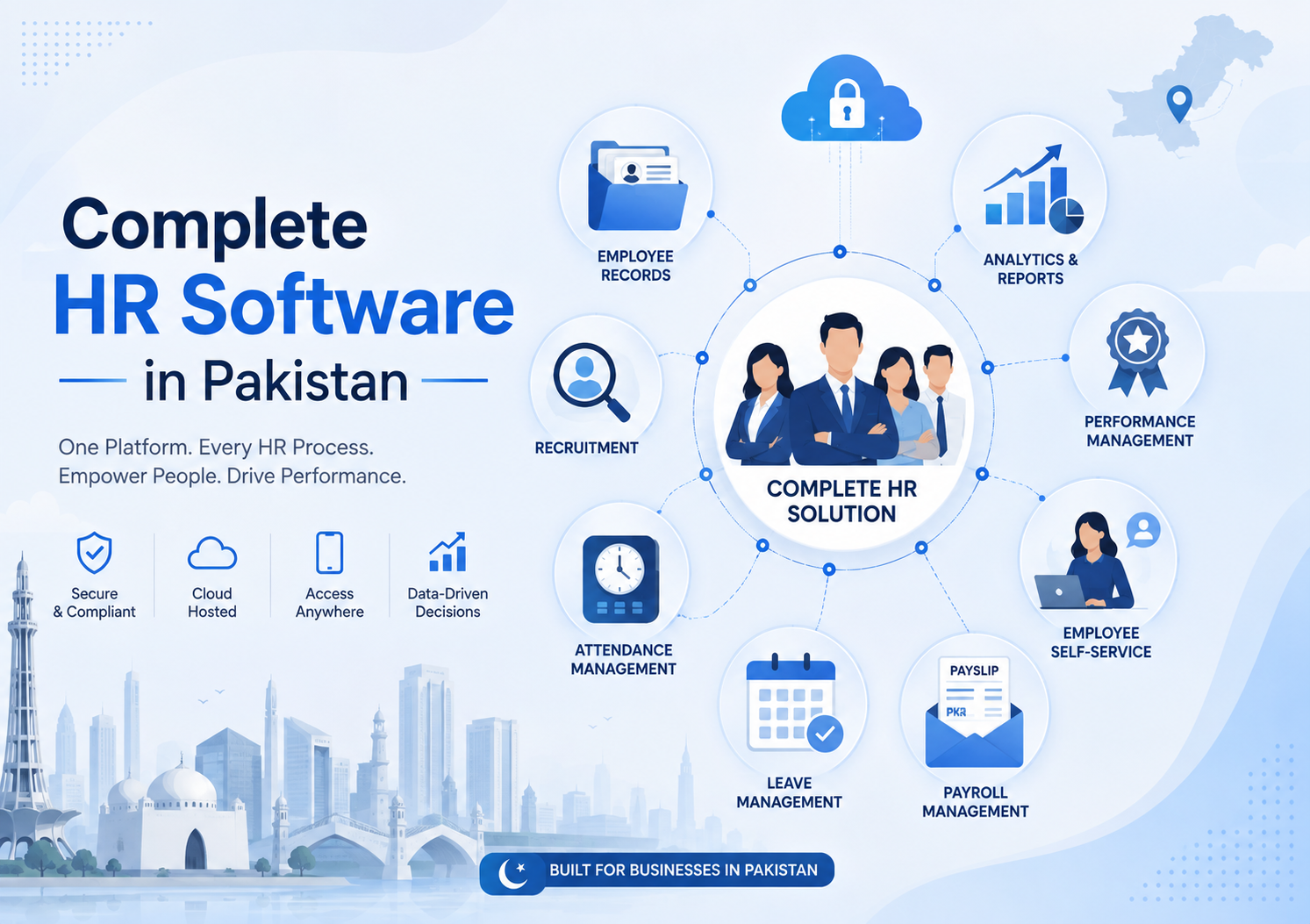
Managing HR through spreadsheets, emails, paper files, WhatsApp approvals, and disconnected tools becomes risky as a business grows. Complete HR software helps companies manage employee records, recruitment, attendance, leave, payroll, performance, employee self-service, and separation from one connected platform.
For businesses in Pakistan, this is more than convenience. HR teams often handle complex payroll rules, multiple branches, biometric attendance, leave policies, approvals, employee documents, performance cycles, and management reports. When these processes are managed separately, HR becomes slow, error-prone, and difficult to control.
That is why many organizations now look for end to end HR software in Pakistan, a system that connects the full employee lifecycle from hiring to exit.
This guide explains what complete HR software means, what modules it should include, how it supports Pakistani businesses, how to choose the right system, and how People.Partners helps organizations build a more connected HR operation.
What is a Complete HR Software?
Complete HR software is a centralized HR system that manages the full employee lifecycle, including recruitment, employee records, attendance, leave, payroll, employee self-service, performance, reporting, and separation. It helps HR teams reduce manual work, improve accuracy, automate approvals, and give management better workforce visibility.
What Makes HR Software “Complete”?
Not every HR tool is complete.
A basic tool may only track attendance. Another may only process payroll. A recruitment tool may only manage applicants. These systems may solve one problem, but they often create another: disconnected data.
Complete HR software connects major HR functions in one platform.
It should help HR answer questions such as:
- Who joined this month?
- Which employees are active, resigned, or on probation?
- Who is absent today?
- Which leave requests are pending?
- Which attendance records affect payroll?
- Which salaries are ready to process?
- Which employees have pending appraisals?
- Which departments have high turnover?
- Which employees are completing separation formalities?
The main value is not only automation. The value is connection.
When recruitment, employee records, attendance, leave, payroll, performance, ESS, and separation work together, HR becomes more accurate, transparent, and easier to manage.
Why Pakistani Businesses Need End-to-End HR Software
Pakistani companies often start with manual HR because it feels simple at first. A small team can manage employee records in Excel, attendance in registers, payroll in spreadsheets, and leave approvals through messages.
But growth changes everything.
As headcount increases, HR must manage:
- Multiple departments
- Branch-wise reporting
- Attendance devices
- Shift schedules
- Overtime rules
- Leave policies
- Payroll inputs
- Employee documents
- Recruitment pipelines
- Performance reviews
- Final settlements
- Management reports
Manual work slows down HR and increases risk.
Example: The Hidden Problem
A manufacturing company has 500 employees. Attendance is recorded through biometric devices, leave requests are approved through email, payroll is prepared in Excel, and employee records are stored in separate folders.
At payroll time, HR finds:
- Some attendance punches are missing.
- Approved leave is not updated.
- Overtime is calculated manually.
- Payroll has to wait for attendance correction.
- Employees ask why salary deductions are wrong.
- Management wants department-wise payroll cost, but reports take days.
This is not one problem. It is a system problem.
End-to-end HR software solves this by connecting employee data, attendance, leave, payroll, and approvals in one workflow.
Manual HR vs Complete HR Software
| Area | Manual HR process | Complete HR software |
| Employee records | Excel and paper files | Centralized employee database |
| Attendance | Registers or separate devices | Integrated attendance tracking |
| Leave | Email, WhatsApp, or forms | Digital leave workflow |
| Payroll | Manual salary sheets | Automated payroll processing |
| Recruitment | CV folders and spreadsheets | Structured applicant tracking |
| Performance | Paper forms or email reviews | Digital appraisal workflows |
| ESS | HR answers every request | Employees access information directly |
| Reports | Manual compilation | Real-time dashboards |
| Audit trail | Weak or missing | System-based approval history |
| Scalability | Difficult as headcount grows | Easier to expand |
The biggest difference is control. Manual HR depends on individuals. Complete HR software depends on defined processes.
Core Modules of Complete HR Software
A complete HR platform should cover the employee lifecycle from hiring to separation.
1. Employee Record Management
Employee records are the foundation of HR.
A complete HR software system should store:
- Personal details
- Employment history
- Department
- Designation
- Reporting manager
- Joining date
- Employment status
- Documents
- Salary information
- Work location
- Employee category
- Emergency contact
- Benefits information
When employee records are centralized, HR can avoid duplicate data and missing documents.
2. Recruitment and Onboarding
Recruitment should not be managed through scattered CV folders.
A strong HR system should support:
- Job requisitions
- Applicant tracking
- Candidate database
- Interview scheduling
- Hiring approvals
- Offer process
- Joining documents
- Onboarding checklists
This helps HR move from vacancy creation to employee joining in a structured way.
3. Attendance Management
Attendance data affects payroll, workforce planning, overtime, and compliance records.
A complete system should support:
- Biometric integration
- Attendance tracking
- Shift scheduling
- Late arrival tracking
- Early departure tracking
- Overtime monitoring
- Attendance correction approvals
- Attendance reports
The existing article already identifies biometric integration, shift scheduling, overtime monitoring, late arrival tracking, reports, and dashboards as attendance features.
4. Leave Management
Leave management becomes difficult when requests are handled through emails or verbal approvals.
A complete HR system should support:
- Configurable leave policies
- Leave request workflows
- Approval hierarchy
- Leave balance tracking
- Leave history
- Notifications
- Leave calendar
- Payroll impact
The existing content highlights configurable leave policies, approval management, balance tracking, leave history, and automated notifications, which should be retained but explained in a broader lifecycle context.
5. Payroll Management
Payroll is one of the most sensitive HR functions.
A complete HR software platform should connect payroll with attendance, leave, allowances, deductions, overtime, taxes, loans, benefits, payslips, and final settlement.
Useful payroll features include:
- Automated salary calculation
- Allowance and deduction management
- Overtime processing
- Payslip generation
- Tax handling
- Payroll reports
- Multi-department payroll processing
The existing article already lists these payroll features and benefits such as faster payroll cycles, fewer payroll errors, and better payroll reporting.
6. Employee Self-Service
Employee Self-Service reduces routine HR workload.
Employees can use ESS to:
- Apply for leave
- View attendance
- Access payslips
- Update personal information
- View HR documents
- Track requests
- Read company announcements
The existing article correctly notes that ESS gives employees quick access to HR information and reduces reliance on HR for routine requests.
7. Performance Management
Performance management helps companies align employee work with business goals.
A complete HR system may support:
- Objective setting
- KPI tracking
- Self-evaluation
- Manager evaluation
- Appraisal forms
- Rating workflows
- Review history
- Development plans
- Performance reports
This prevents performance reviews from becoming disconnected annual paperwork.
8. Separation Management
Employee exit should be documented and controlled.
A complete system should support:
- Resignation workflow
- Exit checklist
- Clearance process
- Final settlement inputs
- Leave encashment
- Asset return
- Exit interview
- Separation reports
This helps HR close employee records properly and reduce settlement disputes.
9. HR Reports and Analytics
Reports help HR move from administration to decision-making.
Useful HR reports include:
- Headcount
- Attendance trends
- Leave utilization
- Payroll cost
- Recruitment pipeline
- Turnover
- Department-wise workforce
- Branch-wise workforce
- Performance summaries
- Pending approvals
- Separation trends
Without reliable reports, management decisions depend on estimates.
Benefits of Complete HR Software
1. Reduced Manual Work
HR teams spend less time updating spreadsheets, chasing approvals, and preparing reports manually.
2. Better Payroll Accuracy
When attendance, leave, allowances, deductions, and employee records are connected, payroll becomes easier to process accurately.
3. Centralized Employee Information
All employee data stays in one system instead of scattered files.
4. Faster Approvals
Leave, attendance corrections, recruitment requests, performance reviews, and separations can move through defined workflows.
5. Improved Employee Experience
Employees can access information, submit requests, and track approvals without waiting for HR.
6. Better Workforce Visibility
Managers can see team attendance, leave, staffing, and pending actions more clearly.
7. Stronger Audit Trail
A complete system records who submitted, approved, edited, or processed key HR actions.
8. Scalable HR Operations
As the company grows, HR can add more users, departments, branches, policies, and workflows without rebuilding everything manually.
Who Needs Complete HR Software in Pakistan?
Complete HR software in Pakistan is useful for any organization that wants to manage people more systematically.
It is especially valuable for:
- SMEs growing beyond manual HR
- Mid-sized companies with 100–1,000 employees
- Enterprises with multiple locations
- Manufacturing companies with shifts and overtime
- Retail and distribution businesses with branch teams
- Healthcare organizations with different staff categories
- Educational institutions managing academic and admin staff
- Professional services firms with performance and attendance needs
- Construction companies managing site-based employees
- Hospitality businesses with shift-based workforce planning
The existing article also identifies SMEs, mid-sized companies, enterprises, and industries such as manufacturing, FMCG, banking, healthcare, and technology as relevant users.
How People.Partners Supports End-to-End HR Management
People.Partners is designed as a complete HR and payroll platform for Pakistani organizations. Its public product page describes modules such as HR Planning, Recruitment Manager, Personnel Manager, Attendance Manager, Leave Manager, Training Manager, Performance Manager, Timesheet, Expense Manager, Succession Planning, Separation Manager, Payroll, and Employee Self-Service Portal.
The value of People.Partners is not only that it offers many modules. The value is that these modules can work together across the employee lifecycle.
Example of a Connected HR Workflow
A candidate is hired through recruitment. Their record becomes part of personnel management. Attendance and leave policies are assigned. The employee uses ESS for requests. Attendance and leave data support payroll. Performance reviews track growth. If the employee exits, separation and final settlement are handled through a controlled workflow.
This is what end-to-end HR software should do: reduce handovers, duplicate data entry, and disconnected decisions.
Why This Matters for Pakistani Businesses
People.Partners is relevant for businesses that need:
- Local HR and payroll workflows
- Attendance and payroll connection
- Employee Self-Service
- Multi-module HR automation
- Workforce reporting
- Scalable HR operations
- Local implementation and support
People.Partners’ public materials also position the platform as cloud-ready and suitable for organizations of different sizes, with automation across recruitment, attendance, leave, payroll, performance, employee engagement, and ESS.
Conclusion
Complete HR software is no longer just a digital replacement for HR files. It is the operating system for people management.
For Pakistani businesses, the real challenge is not only managing payroll, attendance, leave, recruitment, or performance separately. The bigger challenge is connecting all of these processes so HR data flows accurately across the employee lifecycle.
That is why complete HR software and end to end HR software in Pakistan are becoming important for SMEs, growing companies, and enterprises.
A connected HR platform helps reduce manual work, improve payroll accuracy, centralize employee information, speed up approvals, improve employee experience, and give leadership better workforce visibility.
People.Partners supports this shift by bringing core HR, recruitment, attendance, leave, payroll, performance, employee self-service, reporting, and separation into one connected HR environment.
If your HR team is still managing people through scattered files, spreadsheets, and disconnected tools, it may be time to move toward a complete HR system that can grow with your business.
Request a People.Partners demo to see how end-to-end HR software can simplify your workforce operations.
FAQ
What is end to end HR software in Pakistan?
End to end HR software in Pakistan is an integrated HR platform designed to manage the full employee lifecycle for Pakistani businesses, including local HR, attendance, payroll, leave, reporting, and employee service needs.
Which is the best complete HR software?
People.Partners – Complete HR software is a centralized platform that manages major HR functions such as employee records, recruitment, attendance, leave, payroll, employee self-service, performance, reporting, and separation.
Can complete HR software manage payroll?
Yes. Complete HR software like People.Partners can manage salary calculations, allowances, deductions, overtime, payslips, tax handling, payroll reports, and payroll inputs from attendance and leave.
Comments are closed.