
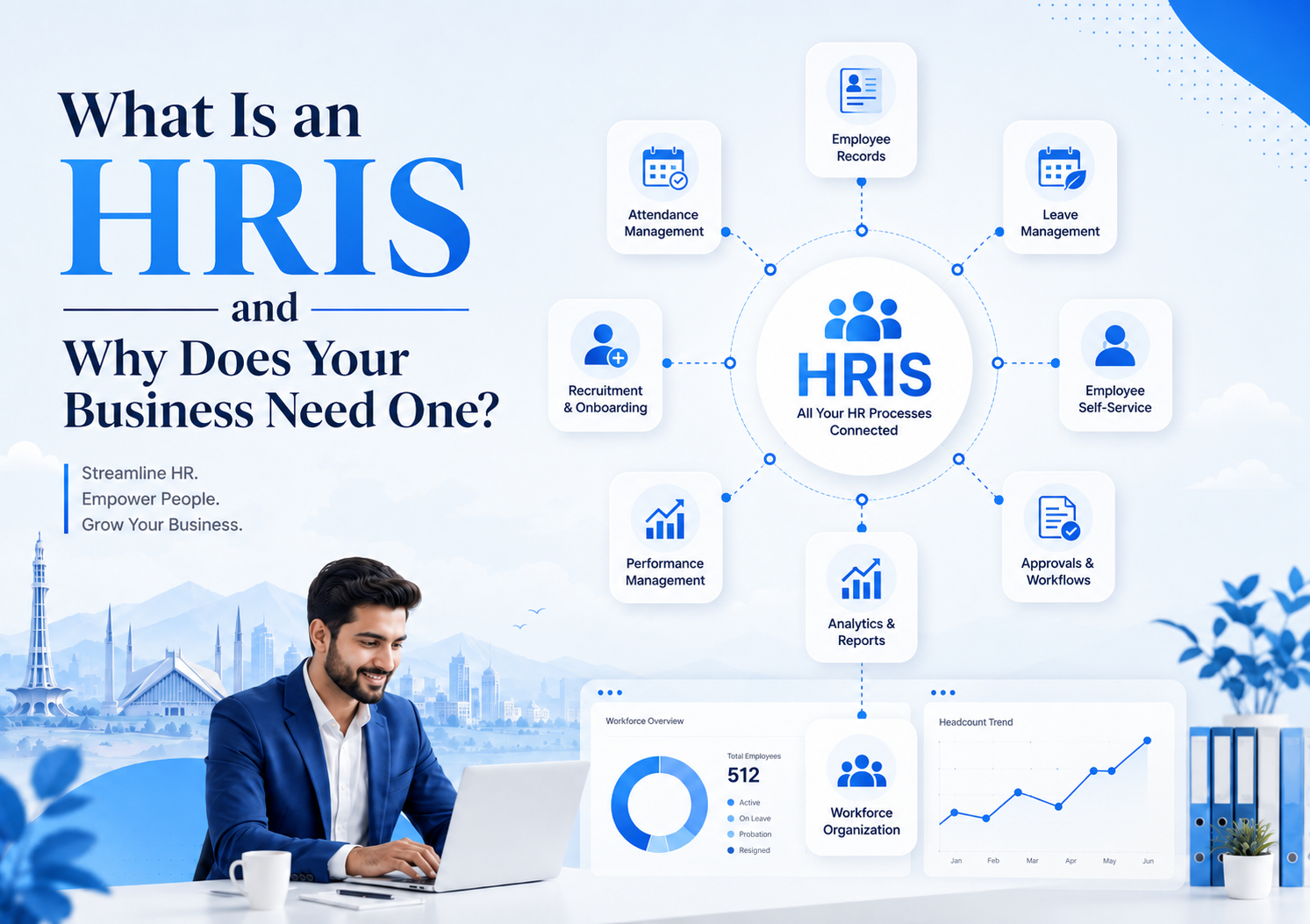
An HRIS is a Human Resource Information System that helps businesses manage employee data, attendance, leave, recruitment, payroll inputs, employee self-service, performance records, and HR reporting in one centralized platform. For Pakistani businesses, an HRIS is no longer only for large enterprises. SMEs, startups, manufacturing companies, service businesses, hospitals, schools, and multi-branch organizations now need structured HR systems to reduce manual work and improve workforce decisions.
Many companies begin with Excel sheets, paper files, WhatsApp approvals, and scattered email records. That may work for a small team, but it becomes risky as the workforce grows. Employee records get duplicated. Attendance is difficult to verify. Leave balances become disputed. Recruitment data is lost. Managers delay approvals. HR spends more time searching for information than improving employee experience.
A good HRIS gives HR teams one reliable source of employee information. It connects people, policies, workflows, and reports so that HR can move from administration to strategy.
This guide explains what an HRIS is, how it works, why businesses in Pakistan need one, what features to look for, and how People.Partners supports modern HR operations without making the article sound like a product brochure.
Why Businesses Need an HRIS
Businesses need an HRIS because manual HR processes become difficult to control as employee numbers, departments, shifts, branches, and policies grow. An HRIS improves employee data accuracy, reduces paperwork, speeds up approvals, supports compliance records, improves reporting, and gives HR and management better visibility into the workforce.
What Does HRIS Stand For?
HRIS stands for Human Resource Information System.
It is a digital system that manages employee information and HR workflows. In simple words, it works like the central database and control center for HR.
An HRIS may include:
- Employee records
- Attendance management
- Leave management
- Recruitment tracking
- Employee onboarding
- Employee Self-Service
- Document management
- HR approvals
- Performance records
- HR analytics
- Payroll inputs
- Organization structure
- Reporting dashboards
The most important point is that an HRIS connects HR data instead of keeping it scattered across different files and departments.
HRIS vs HRMS vs HCM: What Is the Difference?
These terms are often used together, but they do not always mean exactly the same thing.
| Term | Meaning | Main Focus |
| HRIS | Human Resource Information System | Employee data and core HR processes |
| HRMS | Human Resource Management System | Broader HR operations, often including payroll, attendance, leave, and workflows |
| HCM | Human Capital Management | Strategic workforce management, talent, performance, engagement, and development |
In practice, many software providers use these terms interchangeably. When choosing a system, do not focus only on the label. Focus on what the software actually does.
Ask:
- Can it manage employee records?
- Can it connect attendance, leave, and payroll inputs?
- Can employees use self-service?
- Can managers approve requests?
- Can HR generate reliable reports?
- Can it grow with the company?
For most businesses, the best option is a system that combines HRIS, HRMS, and HCM capabilities according to business needs.
How an HRIS Works
An HRIS works by collecting employee and HR data into one central platform, then using workflows to manage routine HR tasks.
A typical HRIS process looks like this:
- HR creates or imports employee records.
- Employees are assigned departments, roles, managers, shifts, policies, and locations.
- Attendance, leave, recruitment, performance, and approvals are processed through the system.
- Employees use self-service to view information or submit requests.
- Managers approve or reject requests based on defined workflows.
- HR reviews reports, exceptions, documents, and workforce data.
- Payroll or finance teams use approved HR data for salary processing where payroll integration exists.
This structure reduces duplicate data entry and makes HR information easier to trust.
Why Pakistani Businesses Are Moving Toward HRIS Software
Pakistani organizations are dealing with more complex HR needs than before. Even small and mid-sized companies now manage multiple employee types, attendance devices, flexible policies, hybrid teams, branch operations, and growing compliance expectations.
Common HR challenges in Pakistan include:
- Manual employee recordkeeping
- Attendance disputes
- Incorrect leave balances
- Slow approvals
- Payroll input errors
- Missing documents
- Recruitment delays
- Poor visibility across branches
- Lack of employee self-service
- Weak reporting for management
- Difficulty tracking performance records
An HRIS helps by giving HR teams a structured system instead of scattered files.
Practical Example
A company with 300 employees across Karachi, Lahore, and Islamabad tracks leave through email. One branch manager approves leave verbally, another uses WhatsApp, and HR updates Excel manually at the end of the month.
By payroll time, HR finds three issues:
- Some approved leaves were never recorded.
- Some employees have negative balances.
- Some absences were treated as unpaid leave by mistake.
An HRIS prevents this by creating one leave request workflow, one approval record, and one balance history.
Core Features of a Good HRIS
A strong HRIS should support daily HR operations while also helping management make better people decisions.
1. Employee Database
The employee database is the foundation of an HRIS.
It should store:
- Personal details
- Employment history
- Department and designation
- Reporting manager
- Joining date
- Employment status
- Documents
- Contact information
- Salary-related inputs
- Benefits information
- Work location
- Employee category
A clean employee database helps HR avoid duplicate records and missing information.
2. Attendance Management
Attendance management helps businesses track employee working time.
An HRIS may connect with biometric attendance, mobile attendance, shifts, rosters, late arrivals, early departures, overtime, and absence records.
This is especially useful for:
- Manufacturing companies
- Retail chains
- Hospitals
- Schools
- Security teams
- Field employees
- Multi-branch businesses
3. Leave Management
Leave management helps employees apply for leave and managers approve it through a defined workflow.
A good HRIS should support:
- Annual leave
- Casual leave
- Sick leave
- Unpaid leave
- Compensatory leave
- Leave balances
- Leave approval hierarchy
- Leave calendar
- Leave history
- Leave reports
This improves transparency and reduces employee disputes.
4. Recruitment Management
Recruitment becomes difficult when CVs, interview notes, approvals, and candidate communication are scattered.
An HRIS can help manage:
- Job openings
- Candidate records
- Shortlisting
- Interview scheduling
- Hiring approvals
- Candidate status
- Offer process
- Recruitment reports
This gives HR and hiring managers a clearer recruitment pipeline.
5. Employee Self-Service
Employee Self-Service allows employees to access HR services without contacting HR for every small request.
Employees may use ESS to:
- View personal information
- Apply for leave
- View attendance
- Download payslips where payroll is connected
- Submit requests
- Track approvals
- Update basic details
- View policies or documents
ESS saves time and improves employee experience.
6. Performance Management
Performance management features help companies track employee goals, reviews, feedback, ratings, and development plans.
A good system should support:
- Performance cycles
- Goal setting
- Manager feedback
- Self-evaluation
- Review forms
- Rating history
- Development plans
- Performance reports
This helps businesses move away from informal or inconsistent evaluations.
7. Workflow Approvals
HR approvals should not depend on memory or email chains.
An HRIS should support approval workflows for:
- Leave
- Attendance correction
- Recruitment
- Employee changes
- Documents
- Performance reviews
- HR requests
Clear workflows create accountability.
8. HR Reporting and Analytics
HR reporting helps management understand the workforce.
Useful reports include:
- Headcount
- Turnover
- Attendance
- Absence trends
- Leave balances
- Hiring pipeline
- Department-wise employees
- Branch-wise employees
- Performance summaries
- HR request status
Good reporting helps HR answer management questions quickly.
Benefits of an HRIS for Businesses
Better Data Accuracy
When employee records are stored in one system, HR can reduce duplicate entries, outdated information, and missing documents.
Faster HR Processes
Leave approvals, attendance corrections, recruitment updates, and HR requests can move faster through digital workflows.
Improved Employee Experience
Employees do not need to ask HR for every leave balance, payslip, attendance detail, or request update.
Stronger Compliance Records
An HRIS helps maintain employee records, approval history, attendance data, leave records, and policy documentation.
Better Workforce Visibility
Managers can see team availability, absence patterns, staffing gaps, and employee information more easily.
Reduced HR Workload
HR spends less time updating spreadsheets, chasing approvals, and answering repeated questions.
Better Decision-Making
Management can use HR reports to understand turnover, hiring needs, attendance patterns, and workforce productivity.
When Should a Company Move From Excel to HRIS?
A company should move from Excel to HRIS when HR information becomes difficult to control, update, verify, or report.
Common warning signs include:
- HR uses multiple Excel files
- Employees ask HR for the same information repeatedly
- Managers approve leave through WhatsApp
- Attendance and payroll records do not match
- Recruitment data is scattered
- Reports take hours or days to prepare
- Employee documents are missing
- There is no approval audit trail
- HR cannot easily track headcount or turnover
- The business is expanding to new branches
Excel is useful for lists. It is not a complete HR management system.
How to Choose the Right HRIS in Pakistan
Choosing the right HRIS is a business decision, not just a software purchase.
Use this checklist:
- Does it support Pakistani HR workflows?
- Can it manage attendance and leave?
- Does it offer Employee Self-Service?
- Can it support recruitment and performance?
- Is it suitable for SMEs and enterprises?
- Can it handle multiple branches?
- Does it provide useful reports?
- Can workflows be customized?
- Is data access controlled by role?
- Is local support available?
- Can it grow with your business?
- Is it easy for employees to use?
The best HRIS should fit your current HR needs while supporting future growth.
People.Partners and HRIS for Pakistani Businesses
People.Partners supports HR teams by connecting core HR processes in one system. Instead of managing employee data, attendance, leave, recruitment, self-service, and performance in separate tools, businesses can use People.Partners to create a more structured HR environment.
The value is not just automation. The value is better visibility, faster approvals, cleaner records, and a smoother employee experience.
People.Partners can help organizations:
- Maintain employee records
- Manage attendance
- Automate leave workflows
- Support recruitment processes
- Enable Employee Self-Service
- Track performance activities
- Improve HR reporting
- Support multi-branch HR operations
- Reduce repetitive HR administration
For Pakistani SMEs and enterprises, an HRIS like People.Partners can help HR teams move from manual recordkeeping to more reliable, data-driven HR management.
Conclusion
An HRIS is more than an employee database. It is a structured system that helps businesses manage people, policies, approvals, and workforce information with greater accuracy and visibility.
For Pakistani businesses, the need for HRIS is growing because manual HR processes cannot support modern workforce expectations. Employees want faster service. Managers want better visibility. Business owners want reliable reports. HR teams want fewer manual tasks and stronger control.
A good HRIS helps connect employee records, attendance, leave, recruitment, employee self-service, performance, workflows, and reporting. It gives HR teams the foundation they need to move from paperwork to strategic workforce management.
People.Partners supports this shift by helping Pakistani SMEs and enterprises organize HR operations in one connected platform.
If your HR team is still managing employee records, leave, attendance, and approvals through spreadsheets or scattered tools, now is the right time to explore a modern HRIS.