
As the business grow, payroll becomes more difficult to manage manually. More employees mean more salary calculations, allowances, deductions, overtime, leaves, loans, advances, tax calculations, pay slips, and payroll records to maintain. What may have worked for a small team can quickly become inefficient and risky as the organization expands.
That is why choosing the best Payroll Software in Pakistan is an important decision for growing businesses.
The right payroll system does more than calculate salaries. It should help HR and finance teams manage payroll accurately, connect payroll with attendance and leave, maintain employee records, support local payroll requirements, reduce repetitive work, and provide reliable reports for management.
For businesses in Pakistan, payroll also involves local requirements such as income tax, EOBI, Social Security, provident fund, gratuity, salary deductions, and other organization-specific policies. A payroll solution should therefore be flexible enough to handle these requirements while remaining easy for HR and employees to use.
In this guide, we explain how growing businesses can evaluate payroll software, which features matter most, common mistakes to avoid, and what to look for before making a final decision.
Why Growing Businesses Need Payroll Software
Payroll becomes increasingly complex as the number of employees increases.
A company with 20 employees may be able to manage some payroll activities through spreadsheets and manual calculations. But when the workforce reaches hundreds or thousands of employees, manually maintaining salary information becomes time-consuming and increases the possibility of errors.
Common challenges include:
- Repetitive salary calculations
- Manual attendance and overtime adjustments
- Incorrect deductions
- Delayed pay slips
- Difficulty managing loans and advances
- Complex final settlements
- Maintaining employee salary history
- Payroll approval delays
- Difficulty preparing payroll reports
- Increased risk of data-entry mistakes
Payroll software helps centralize these processes and creates a more structured payroll workflow.
Instead of maintaining separate spreadsheets for employees, salaries, deductions, attendance, and payroll reports, HR and finance teams can manage these activities through an integrated system.
What Should the Best Payroll Software in Pakistan Offer?
There is no single payroll system that is perfect for every organization. The right choice depends on company size, industry, payroll complexity, workforce structure, and future growth plans.
However, a strong payroll platform should provide several essential capabilities.
1. Employee Information Management
Payroll starts with accurate employee information.
The system should maintain important employee details such as:
- Employee profile
- Employment information
- Department and designation
- Salary information
- Allowances
- Deductions
- Joining information
- Bank or payment information
- Employment status
- Payroll history
Centralizing employee information reduces the need to maintain the same information across multiple spreadsheets and systems.
For a growing business, this becomes particularly important because HR data changes frequently.
2. Automated Salary Processing
Salary calculation is one of the most important functions of payroll software.
A suitable system should be able to process:
- Basic salary
- Allowances
- Deductions
- Overtime
- Bonuses
- Arrears
- Loans
- Advances
- Leave-related adjustments
- Other organization-specific payroll components
Automation reduces repetitive calculations and helps payroll teams process salaries more consistently.
The goal is not simply to make payroll faster. It is to create a controlled process where calculations can be reviewed, approved, processed, and reported systematically.
3. Attendance and Payroll Integration
Payroll and attendance are closely connected.
Employee attendance can affect salary calculations through:
- Absences
- Late arrivals
- Early departures
- Overtime
- Shift schedules
- Leave
- Holidays
- Attendance adjustments
If HR teams have to manually transfer attendance information into payroll every month, there is a greater possibility of errors.
The best Payroll Software in Pakistan should therefore work with attendance and leave information so that payroll calculations are based on reliable workforce data.
This integration is especially valuable for organizations with multiple branches, shifts, departments, or large workforces.
4. Leave Management Integration
Leave management is another area that can affect payroll.
Employees may have different leave policies, balances, approval processes, and salary implications. Managing this information manually can become complicated as the organization grows.
A good payroll system should allow HR teams to connect leave information with payroll where required.
This helps reduce manual adjustments and gives HR better visibility into employee leave and payroll records.
5. Payroll Tax and Local Requirements
One of the most important considerations when selecting payroll software in Pakistan is whether the system can support local payroll requirements.
Businesses may need to manage areas such as:
- Income tax
- EOBI
- Social Security
- Provident fund
- Gratuity
- Salary deductions
- Loans and advances
- Organization-specific benefits
A payroll system should provide flexibility for configuring the rules and policies relevant to the organization.
Before purchasing software, businesses should ask the vendor how the system handles changes in payroll rules and whether the configuration can be updated when requirements change.
6. Loans and Salary Advances
Many organizations provide employees with loans or salary advances.
Managing these manually can create unnecessary work for payroll teams. HR needs to know the original amount, installment structure, deductions already made, and remaining balance.
Payroll software should provide a structured way to manage employee loans and advances and incorporate applicable deductions into payroll processing.
This improves visibility for both HR and finance teams.
7. Pay slip Management
Employees expect timely and accurate pay slips.
A payroll platform should make it easy for HR to generate and distribute pay slips after payroll processing.
Employees should be able to access relevant payroll information without repeatedly contacting HR for basic documents.
This can improve transparency and reduce administrative workload.
8. Payroll Reports and Analytics
Payroll data is valuable for more than salary processing.
Management may need reports covering:
- Salary expenses
- Employee deductions
- Allowances
- Payroll summaries
- Department-wise payroll
- Employee payroll history
- Tax-related information
- Loans and advances
- Payroll costs
A good reporting system helps HR and finance teams understand payroll costs and identify unusual or incorrect entries before finalizing payroll.
For growing businesses, this visibility becomes increasingly important for workforce planning and budgeting.
9. Payroll Approval Workflows
Payroll should not always be a single-person process.
Growing organizations often require payroll to move through different stages such as preparation, verification, approval, and final processing.
A payroll system with approval workflows can help establish accountability.
It can make it easier to determine:
- Who prepared the payroll
- Who reviewed it
- Who approved it
- When changes were made
- Which payroll period was processed
This creates stronger control over payroll operations.
10. Security and User Access
Payroll contains sensitive employee information.
Salary details, deductions, tax information, bank information, and employment records should not be accessible to every user.
When comparing the best Payroll Software in Pakistan, businesses should evaluate security and access-control capabilities.
Look for features such as:
- Role-based access
- User permissions
- Approval controls
- Audit trails
- Secure employee records
- Controlled access to salary information
A growing business should think about payroll security from the beginning rather than waiting until the workforce becomes much larger.
How to Choose Payroll Software for a Growing Business?
Selecting payroll software is not just about comparing feature lists. The right system should solve your current payroll challenges while giving your business enough flexibility to grow.
Here are 5 practical steps to choose the right payroll software:
Step 1: Understand Your Payroll Needs and Complexity
Start by reviewing how your payroll currently works and identify the areas that create the most manual effort.
Consider:
- Where employee data is stored
- How salaries, allowances, and deductions are calculated
- How attendance and leave affect payroll
- How loans and advances are managed
- How payroll is approved
- How payslips are distributed
- Which reports management needs
- Number of employees, departments, and branches
- Shift-based employees, overtime, bonuses, and incentives
Understanding your payroll structure will help you identify the features and level of automation your business actually needs.
Step 2: Look for HR Integration and Automation
Payroll should not operate as a standalone process. The best solution should connect payroll with other important HR functions.
Ideally, the workflow should look like:
Employee Management → Attendance → Leave → Payroll → Payslip → Reporting
Integration reduces manual data entry and helps HR teams use consistent employee, attendance, and leave information during payroll processing.
Look for features such as:
- Automated salary processing
- Attendance integration
- Leave integration
- Allowance and deduction management
- Loan and advance management
- Automated payslips
- Payroll reports
Step 3: Evaluate Ease of Use and Customization
Powerful software is only useful if HR and finance teams can use it efficiently.
During a software demo, ask the vendor to demonstrate real payroll tasks, such as:
- Adding an employee
- Configuring salary structures
- Processing attendance
- Managing deductions
- Finalizing payroll
- Generating payslips
- Creating payroll reports
At the same time, check whether the system can adapt to your business requirements.
Your organization may introduce new:
- Allowances
- Departments
- Branches
- Employee categories
- Payroll policies
- Approval workflows
- Reporting requirements
The software should provide enough flexibility to accommodate these changes.
Step 4: Check Vendor Support and Local Payroll Expertise
Implementing payroll software is not the end of the process. Your HR and finance teams may need ongoing assistance with:
- Initial configuration
- Data migration
- Payroll setup
- User training
- Troubleshooting
- System changes
- Payroll policy configuration
For businesses in Pakistan, it is also important to evaluate whether the vendor understands local payroll requirements and business practices.
Reliable local support can make implementation easier and help your team resolve payroll-related issues more efficiently.
Step 5: Think About Scalability and Future Growth
A growing business should not have to replace its payroll software every time its workforce expands.
Ask:
Can this system handle our future growth?
For example, if your organization currently has 100 employees but expects to grow to 500 or 1,000 employees, the payroll system should be capable of supporting that expansion.
Evaluate scalability across:
- Employee numbers
- Branches and departments
- Payroll complexity
- Users and access levels
- Reporting requirements
- HR integrations
The right payroll software should support your business today while giving you the flexibility to grow tomorrow.
Why People.Partners is a Strong Choice for Growing Businesses
People.Partners is an integrated HR and Payroll Software in Pakistan designed to help businesses manage employee information and HR operations through one platform.
The solution brings together important HR processes such as employee management, attendance, leave, payroll, performance, and employee self-service.
For payroll teams, this means less dependence on disconnected spreadsheets and manual processes.
People.Partners supports important payroll activities including:
- Employee salary management
- Payroll processing
- Allowances and deductions
- Loans and advances
- Tax-related payroll processing
- Attendance and leave integration
- Pay slips
- Payroll reporting
- Final settlements
- Employee self-service
The integrated approach is particularly useful for growing organizations because payroll information can be connected with the HR processes that generate it.
For example, attendance and leave information can contribute to payroll processing, while employees can access relevant information through employee self-service capabilities.
This creates a more connected HR and payroll environment.
What Makes Payroll Software a Good Long-Term Investment?
The value of payroll software becomes clearer when looking beyond monthly salary processing.
A well-designed payroll system can help an organization:
Reduce Administrative Work
Automation reduces repetitive data entry and calculations.
Improve Payroll Accuracy
Centralized information and automated processing can reduce avoidable manual errors.
Improve Employee Trust
Accurate and timely salaries and payslips contribute to a better employee experience.
Strengthen Payroll Control
Approval workflows, permissions, and centralized records improve accountability.
Improve Management Visibility
Reports help management understand payroll costs and workforce-related expenses.
Support Business Growth
A scalable HR and payroll platform can support the organization as employee numbers and operational complexity increase.
Final Checklist: Choosing the Best Payroll Software in Pakistan
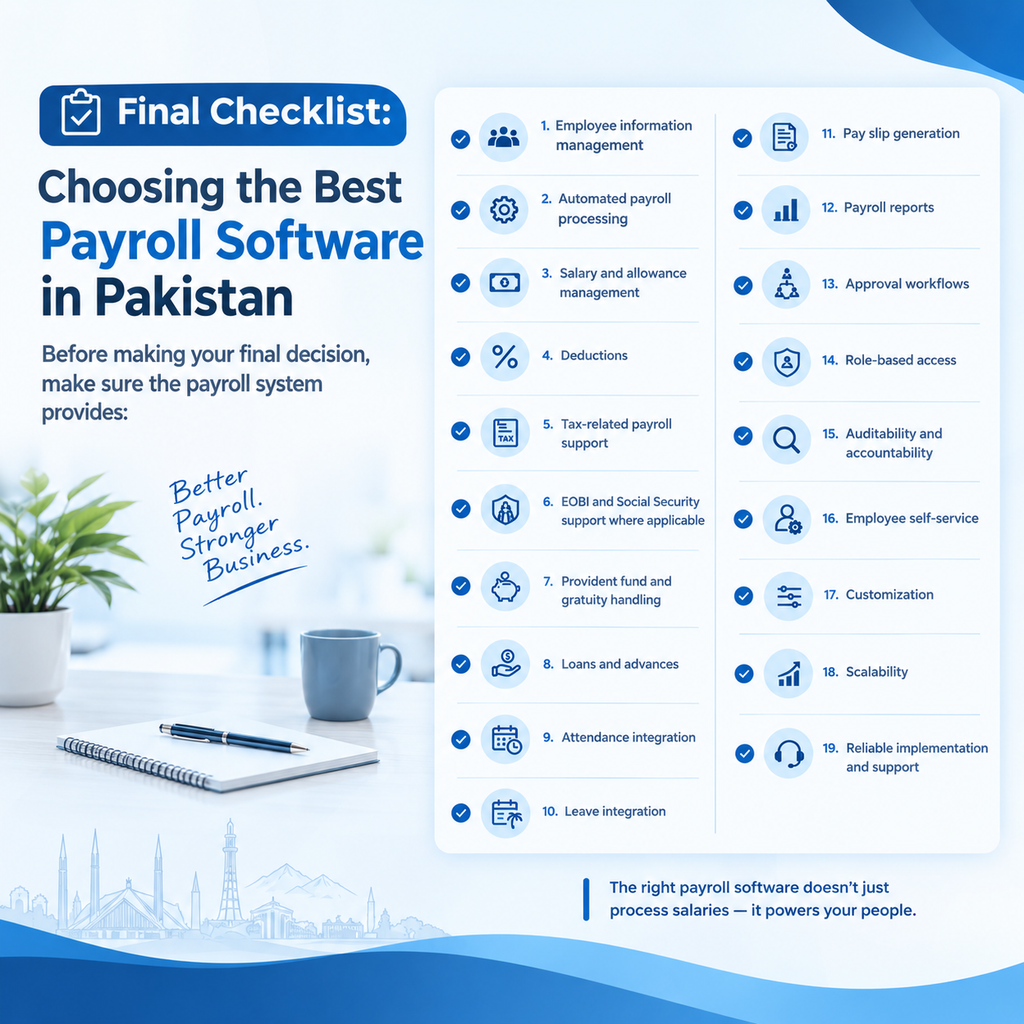
The best Payroll Software in Pakistan is ultimately the system that fits your organization’s payroll structure, supports local requirements, reduces manual work, provides reliable control, and can grow with your business.
Conclusion
Choosing payroll software is an important decision for any business moving beyond manual payroll management.
As employee numbers increase, payroll becomes more complex. Attendance, leave, allowances, deductions, taxes, loans, advances, bonuses, pay slips, reporting, and approvals all need to work together.
The right payroll system can help HR and finance teams reduce repetitive work, improve accuracy, strengthen payroll controls, and provide employees with a more transparent experience.
For growing businesses in Pakistan, People.Partners provides an integrated HR and payroll platform that brings employee management, attendance, leave, payroll, reporting, and employee self-service together in one system.
If your business is looking for a payroll solution that can support today’s workforce and tomorrow’s growth, evaluate the software based on its functionality, local payroll capabilities, integrations, ease of use, scalability, security, and support—not just its price.
Frequently Asked Questions
What is the best Payroll Software in Pakistan for a growing business?
The best payroll software depends on the organization’s size, payroll complexity, HR processes, and future growth plans. A suitable system should support salary processing, attendance, leave, deductions, loans, pay slips, reporting, local payroll requirements, security, and scalability.
What features should payroll software have in Pakistan?
Important features include employee management, automated payroll, salary structures, allowances, deductions, tax-related processing, EOBI, Social Security, provident fund, gratuity, attendance and leave integration, loans and advances, pay slips, reports, approvals, and employee self-service.
Is payroll software better than Excel?
For a growing business, payroll software generally provides stronger automation, centralized records, access control, reporting, integration, and scalability than manually maintained spreadsheets.
Can payroll software integrate with attendance?
Yes. An integrated payroll system can use attendance information such as absences, overtime, shifts, and other applicable attendance data as part of payroll processing.
Can payroll software manage employee loans and advances?
A payroll system can provide structured management of employee loans and salary advances, including applicable payroll deductions and records.
Why is local payroll support important in Pakistan?
Payroll practices in Pakistan can involve local requirements such as income tax, EOBI, Social Security, provident fund, and gratuity. Businesses should select software that can accommodate the payroll requirements applicable to their organization.
What business should check before buying payroll software?
Businesses should evaluate features, Pakistani payroll requirements, attendance and leave integration, customization, security, reporting, employee self-service, scalability, implementation, training, and vendor support before making a decision.