
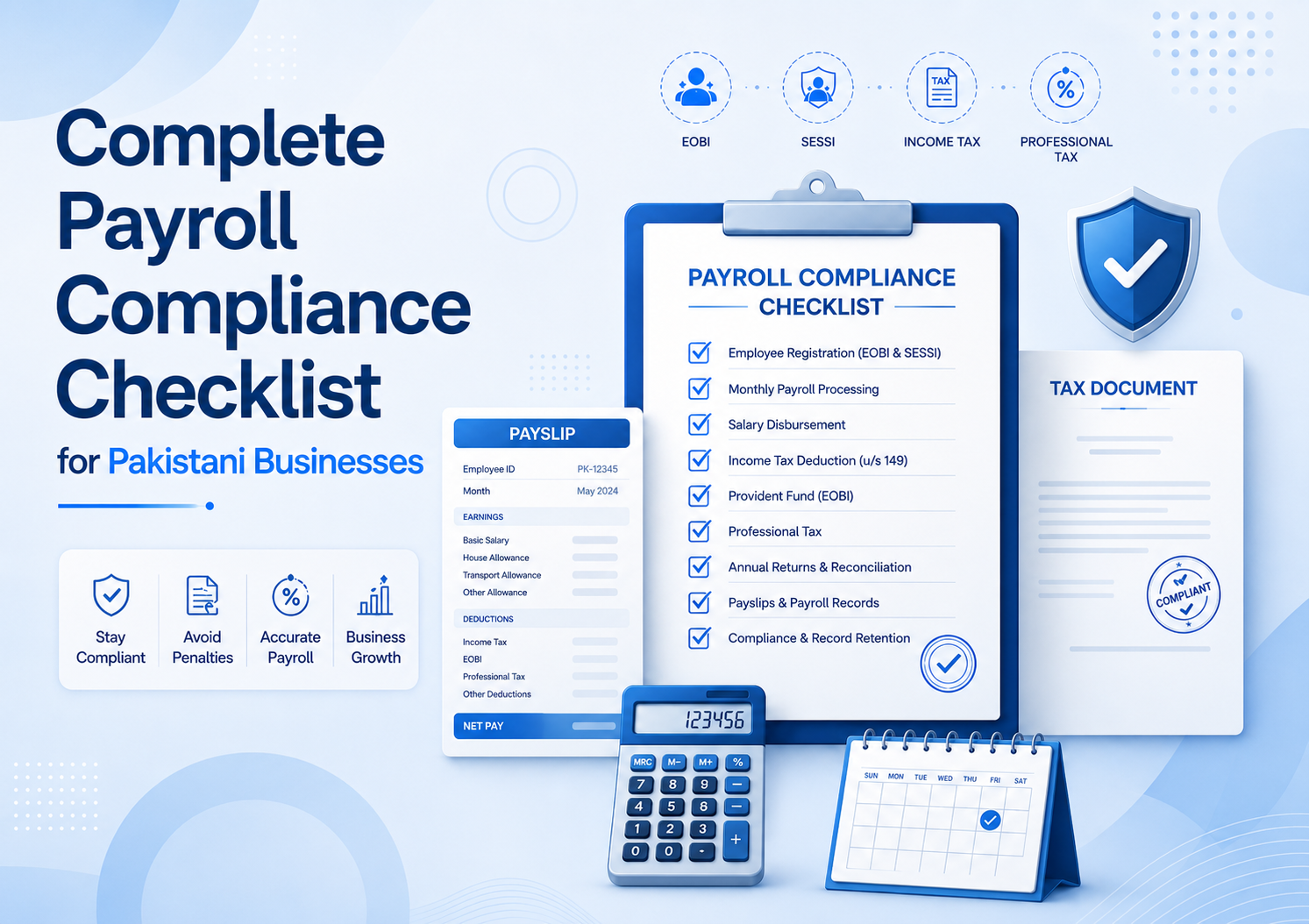
Payroll in Pakistan is more than calculating salaries at the end of the month. For HR teams, finance departments, and business owners, a complete payroll compliance checklist for Pakistani businesses helps ensure that salaries, tax deductions, statutory contributions, attendance, leave, overtime, benefits, and employee records are handled accurately and on time.
Payroll mistakes are expensive. A missed tax deduction, incorrect EOBI contribution, delayed salary, wrong overtime calculation, poor record keeping, or incomplete final settlement can create employee disputes, audit risk, penalties, and loss of trust.
This guide is written for Pakistani businesses that want a practical, HR-led payroll compliance framework, not just a generic payroll feature list. It explains what to check before payroll, during payroll processing, after salary disbursement, and throughout the year.
What Is Payroll Compliance in Pakistan?
Payroll compliance means paying employees correctly while following applicable tax, labor, social security, benefits, documentation, and reporting requirements.
In Pakistan, payroll compliance usually includes:
- Salary structure and employment terms
- Attendance and working hours
- Overtime and leave
- Income tax deduction from salary
- EOBI contributions where applicable
- Provincial social security where applicable
- Provident fund or gratuity where offered or required by policy
- Minimum wage compliance
- Payslips and payroll records
- Final settlement and exit processing
- Audit trails and approvals
Employers are responsible for deducting tax from salary under Section 149 of the Income Tax Ordinance, 2001, and FBR maintains updated withholding tax rate cards for relevant tax years.
Quick Payroll Compliance Checklist
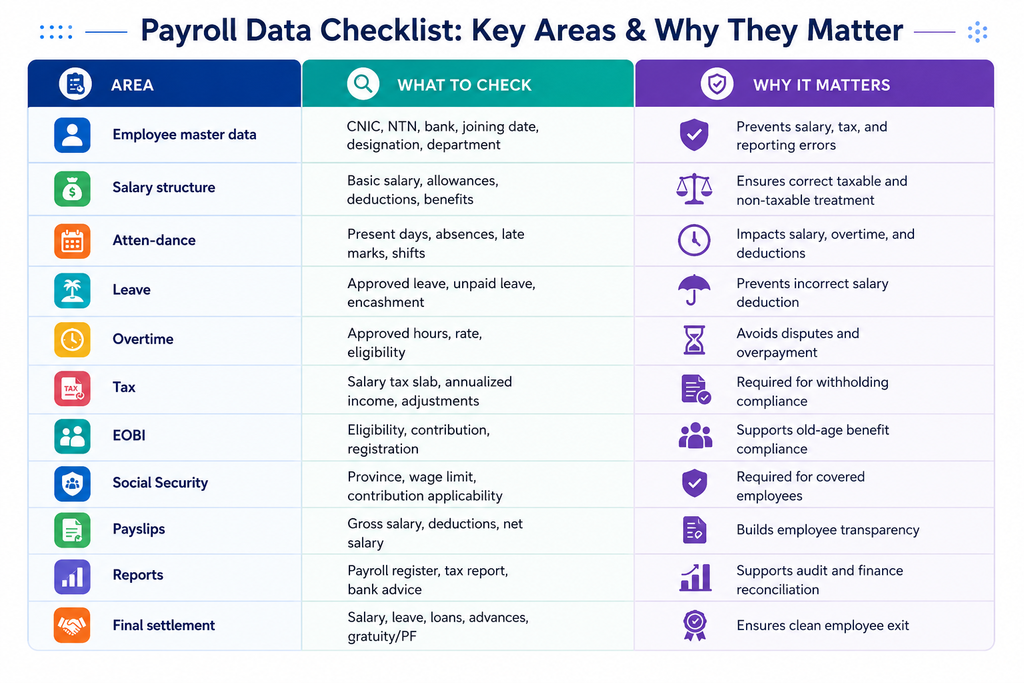
Why Pakistani Businesses Need a Payroll Compliance Checklist
Many payroll issues are not caused by lack of effort. They are caused by disconnected processes.
Attendance may be managed by HR. Salary structures may sit with finance. Tax calculations may be handled in spreadsheets. Leave approvals may be tracked manually. EOBI and social security records may be updated separately. When these processes are not connected, errors become difficult to catch before payroll is finalized.
A payroll compliance checklist helps businesses:
- Reduce salary errors
- Avoid missed statutory deductions
- Improve employee confidence
- Prepare for audits
- Standardize payroll processing
- Reduce manual dependency
- Maintain cleaner HR and finance records
- Process payroll faster every month
For growing companies, this checklist also protects continuity. Payroll should not depend on one person’s memory, spreadsheet, or manual formula.
1. Verify Employee Master Data Before Payroll
Payroll compliance begins with clean employee data. If the employee profile is wrong, the payroll will also be wrong.
Employee data to verify
- Full legal name
- CNIC number
- Employee code
- Joining date
- Employment type
- Department and cost center
- Designation and grade
- Work location
- Bank account details
- NTN or tax profile, where available
- EOBI registration status
- Social security registration status
- Salary structure
- Reporting manager
- Attendance policy
- Leave policy
Common mistake
Many companies update salary changes but forget to update employee status, department, location, or statutory registration. This creates mismatches in payroll reports, tax records, and contribution schedules.
Best practice
Before every payroll cycle, HR should run an employee master data validation report. New joiners, resigned employees, transferred employees, salary revisions, bank account changes, and contract changes should be reviewed before payroll processing starts.
2. Confirm Salary Structure and Compensation Components
A compliant payroll system must clearly separate salary components.
Typical payroll components in Pakistan
| Component | Examples |
| Fixed earnings | Basic salary, house rent, utilities, conveyance |
| Variable earnings | Overtime, commission, incentive, bonus |
| Benefits | Medical, fuel, mobile, car, accommodation |
| Statutory deductions | Income tax, EOBI employee share, social security where applicable |
| Company deductions | Loan, advance, asset recovery, late deduction |
| Employer contributions | EOBI employer share, provident fund, gratuity provision, insurance |
Not every component is treated the same for tax, reporting, or company policy. This is why salary structure should not be handled as one flat amount.
Compliance check
Before payroll is processed, confirm:
- Is the salary structure approved?
- Are allowances correctly mapped?
- Are taxable benefits correctly configured?
- Are deductions authorized?
- Are salary revisions effective from the correct date?
- Are arrears or retroactive changes calculated correctly?
- Are bonuses and commissions approved?
3. Check Minimum Wage Compliance
Minimum wage compliance is a core payroll responsibility. Minimum wages are not static; they may change by province and worker category. Sindh, for example, notified minimum monthly wage figures for unskilled workers effective from July 2025, and provincial wage notifications may differ by year and category.
What HR should check
- Employee province or work location
- Employment category
- Applicable minimum wage notification
- Basic wage or gross wage treatment as per applicable law/policy
- Contract workers and outsourced staff exposure
- New wage rates after provincial notifications
Original HR insight
Minimum wage compliance should not be reviewed only once a year. Businesses operating in multiple provinces should maintain a location-wise payroll compliance matrix. This reduces the risk of applying one province’s wage rate to all employees.
4. Validate Attendance, Working Days, and Absences
Attendance is one of the biggest sources of payroll disputes.
Payroll should not be finalized until attendance is locked and approved.
Attendance checks before payroll
- Total working days
- Paid days
- Absent days
- Late arrivals
- Early exits
- Shift changes
- Holidays
- Weekly offs
- Approved leave
- Unpaid leave
- Work-from-home days if policy allows
- Manual attendance corrections
Common risk
Manual attendance corrections without approval can create payroll manipulation risk. A late correction after payroll finalization may also create arrears or recoveries in the next month.
Best practice
Use a cut-off date. For example, attendance corrections must be approved by the department head before payroll processing begins. After payroll is locked, changes should require HR and finance approval.
5. Review Leave, Leave Without Pay, and Leave Encashment
Leave directly affects payroll. If leave balances are not updated, employees may be overpaid or underpaid.
Leave compliance checklist
- Approved annual leave
- Casual leave
- Sick leave
- Unpaid leave
- Maternity or paternity leave where policy applies
- Leave encashment
- Carry-forward balance
- Leave adjustment during resignation
- Leave policy eligibility by employee type
The Factories Act includes provisions on annual holidays and refers to wages for certain leave-related calculations, while shops and establishments laws also regulate employment conditions and records for relevant workplaces.
HR consultant tip
Leave should be integrated with payroll. If leave is managed in Excel and payroll is managed in another system, the chances of missed unpaid leave or wrong encashment increase significantly.
6. Calculate Overtime Correctly
Overtime is often disputed because it depends on eligibility, approved hours, wage basis, shift policy, and applicable law.
Overtime checks
- Is the employee eligible for overtime?
- Are overtime hours approved?
- Is the overtime rate correctly configured?
- Is overtime based on basic salary or another wage definition?
- Are shift-based employees treated correctly?
- Is overtime separated from regular salary in reports?
- Are overtime approvals available for audit?
Some labor inspection checklists specifically review whether overtime, where applicable, is paid at double the ordinary rate of wages.
Common mistake
Paying overtime without approval creates cost leakage. Not paying approved overtime creates employee grievances. Both are compliance failures.
7. Deduct Salary Income Tax Correctly
Income tax deduction from salary is one of the most important payroll compliance areas.
Employers are withholding agents and must deduct tax from taxable salary according to applicable law and FBR rates. FBR’s withholding tax guidance states that withholding agents may be liable when tax is not deducted or not paid to the federal government.
Salary tax checklist
- Confirm employee taxable salary
- Apply current salary tax slabs
- Annualize monthly salary where required
- Include taxable allowances and benefits
- Adjust bonuses, arrears, and commissions
- Record tax already deducted
- Consider approved tax credits or adjustments where applicable
- Generate monthly tax deduction report
- Reconcile deductions with payment challans and returns
Payroll control
Tax should not be calculated manually in separate spreadsheets unless there is a strong review process. Payroll software should calculate tax based on updated tax rules, but HR and finance should still review exceptions.
8. Manage EOBI Contributions Where Applicable
EOBI compliance applies to covered employers and employees under relevant rules. Official information from Pakistan’s Ministry of Overseas Pakistanis and Human Resource Development describes monthly EOBI contribution as 6% of minimum wages, with 5% contributed by the employer and 1% deducted from the employee’s salary.
EOBI checklist
- Confirm establishment applicability
- Register eligible employees
- Maintain employee EOBI numbers
- Calculate employer contribution
- Deduct employee contribution where applicable
- Deposit contributions on time
- Reconcile EOBI payments with payroll
- Maintain monthly contribution reports
- Update resigned and new employees
Common mistake
Companies often deduct EOBI but fail to reconcile employee-wise contribution reports. This creates issues later when employees need service history or benefit verification.
9. Manage Provincial Social Security
Social security is province-specific and must be checked according to the employee’s location and applicable institution.
Sindh Employees’ Social Security regulations refer to employer contribution in respect of employees and describe contribution rates subject to prescribed limits, while official EOBI-related guidance also distinguishes statutory contribution responsibilities.
Social security checklist
- Identify applicable province
- Confirm wage threshold and employee coverage
- Register eligible employees
- Maintain social security numbers
- Calculate employer contribution
- Deposit contribution within deadline
- Reconcile payroll with contribution records
- Update employee status changes
Multi-location insight
A business with employees in Karachi, Lahore, Islamabad, and remote locations should not apply one social security rule blindly. Payroll compliance should be mapped by province, work location, and employee category.
10. Control Loans, Advances, and Deductions
Employee loans and salary advances are common in Pakistani businesses. They must be deducted carefully.
Deduction checklist
- Is the loan approved?
- Is the installment schedule defined?
- Is the deduction allowed under policy?
- Has the employee acknowledged the deduction?
- Is the outstanding balance updated after payroll?
- Are final settlement recoveries calculated correctly?
- Are deductions shown clearly on the payslip?
The Payment of Wages Act deals with responsibility for payment of wages and deductions, making controlled deduction records important for payroll governance.
Best practice
Every recurring deduction should have a source document: approval, amount, schedule, start date, end date, and balance.
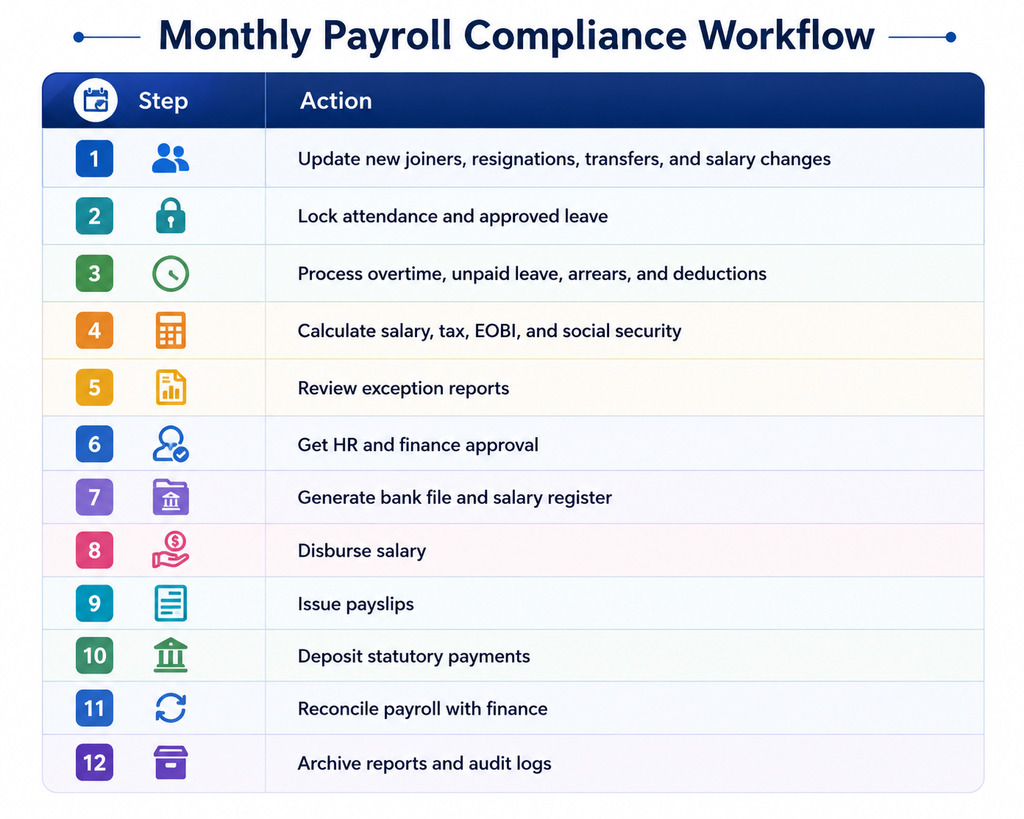
11. Prepare Payroll Approvals Before Disbursement
Payroll should never be processed by one person without review.
Recommended approval flow
| Stage | Owner | Purpose |
| Attendance lock | HR / department heads | Confirm paid days |
| Payroll calculation | Payroll officer | Process salary |
| Exception review | HR manager | Check unusual changes |
| Tax and deduction review | Finance | Verify deductions |
| Final approval | HR/Finance Head | Authorize disbursement |
| Bank upload | Finance | Transfer salaries |
Exception reports to review
- New joiners
- Resigned employees
- Zero salary employees
- Negative salary employees
- Large salary changes
- High overtime
- Unusual tax deductions
- Manual adjustments
- Duplicate bank accounts
- Missing bank accounts
- Employees without CNIC/NTN data
12. Generate Payslips and Employee Payroll Records
Payslips are not only employee communication documents. They are payroll transparency records.
Payslip should include
- Employee name and code
- Department and designation
- Pay period
- Gross salary
- Earnings breakdown
- Deductions breakdown
- Tax deduction
- EOBI/social security deductions if applicable
- Loan or advance deduction
- Net salary
- Leave balance if policy allows
- Bank transfer details where applicable
Why it matters
Clear payslips reduce employee queries. They also help HR explain how salary was calculated.
13. Reconcile Payroll With Finance
Payroll does not end when salaries are transferred. Payroll must reconcile with accounting.
Finance reconciliation checklist
- Payroll register total
- Bank transfer total
- Salary payable account
- Tax payable
- EOBI payable
- Social security payable
- Provident fund payable
- Loan recovery
- Department-wise payroll cost
- Cost center allocation
- Employer contributions
- Accruals and provisions
Common issue
A company may process payroll correctly but post incorrect accounting entries. This creates mismatch between HR payroll reports and finance ledgers.
14. Handle Final Settlement Carefully
Final settlement is one of the most sensitive payroll events.
Final settlement checklist
- Last working day
- Notice period served or recovered
- Unpaid salary
- Leave encashment or adjustment
- Overtime payable
- Bonus or incentive payable
- Loan/advance recovery
- Asset recovery
- Provident fund balance
- Gratuity eligibility
- Tax deduction
- Experience/service letter clearance
- Final payslip
- Employee acknowledgment
HR insight
Final settlement should be processed through a clearance workflow. HR, finance, IT, admin, and department heads should confirm dues before final payment.
15. Maintain Payroll Records for Audit
Payroll compliance depends on documentation.
The Shops and Establishments Rules require employers to maintain prescribed registers and records and produce them for inspection when required.
Records to maintain
- Employee master records
- Appointment letters
- Salary revision letters
- Attendance records
- Leave records
- Overtime approvals
- Payroll registers
- Payslips
- Bank advice files
- Tax deduction reports
- EOBI and social security challans
- Loan approvals
- Final settlement records
- Approval logs
- Audit trails
Best practice
Digital payroll records should be searchable, date-stamped, and access-controlled. This is especially important when HR teams change or when auditors ask for historical payroll evidence.
Common Payroll Compliance Mistakes in Pakistan
Many businesses make the same payroll mistakes repeatedly.
1. Using outdated tax slabs
Tax rates may change annually. Payroll teams should review FBR updates every tax year.
2. Processing payroll before attendance is locked
This creates salary reversals, employee complaints, and manual corrections.
3. Not reconciling statutory deductions
Tax, EOBI, and social security deductions should reconcile with challans, returns, and employee-wise reports.
4. Treating all locations the same
Provincial labor and social security rules may differ. Multi-location businesses need location-wise compliance mapping.
5. Weak approval controls
Payroll without approval workflow increases risk of unauthorized changes.
6. Poor final settlement documentation
Exit disputes often happen when leave, notice period, loans, or gratuity calculations are not documented.
7. Overreliance on spreadsheets
Spreadsheets are flexible, but they are risky for payroll compliance when there is no audit trail, access control, or formula governance.
How Payroll Software Helps Pakistani Businesses Stay Compliant
Payroll software does not replace HR judgment. It reduces manual risk and gives HR and finance better control.
A good HR and payroll system should help businesses:
- Maintain accurate employee records
- Configure salary structures
- Integrate attendance and leave
- Calculate payroll automatically
- Apply tax rules consistently
- Track EOBI and social security
- Manage loans and advances
- Generate payslips
- Run payroll approval workflows
- Maintain audit trails
- Create finance-ready payroll reports
- Support final settlement processing
For HR managers, the biggest benefit is control. For finance teams, it is reconciliation. For employees, it is transparency. For leadership, it is confidence that payroll is being handled consistently.
Where People.Partners Fits In
People.Partners supports Pakistani businesses by connecting HR, attendance, leave, payroll, deductions, approvals, and reporting into a structured HR and payroll environment.
Instead of managing payroll through disconnected spreadsheets, manual attendance files, and separate deduction sheets, businesses can use People.Partners to improve visibility and reduce payroll processing risk.
The value is not just automation. The value is better governance:
- HR has cleaner employee data.
- Finance gets structured payroll reports.
- Employees receive clearer payslips.
- Management gets better cost visibility.
- Auditors get stronger documentation.
- Payroll teams reduce repetitive manual work.
For businesses that are growing, hiring across departments, managing multiple locations, or handling complex salary structures, an integrated payroll system becomes a practical compliance requirement.
Payroll Compliance Checklist by Department
| Department | Responsibility |
| HR | Employee data, attendance, leave, salary changes, final settlement |
| Finance | Tax, bank transfers, reconciliation, accounting entries |
| Department heads | Attendance approvals, overtime approvals, workforce confirmation |
| IT/Admin | Asset clearance, access removal, employee exit support |
| Management | Payroll policy approval, exception approvals, compliance oversight |
Payroll compliance is not only an HR responsibility. It is a shared business control.
Final Payroll Compliance Checklist
Before closing any payroll month, confirm the following:
- Employee master data is updated.
- New joiners and exits are included correctly.
- Salary revisions are approved.
- Attendance is locked.
- Leave without pay is applied.
- Overtime is approved.
- Loans and advances are deducted correctly.
- Income tax is calculated using current rules.
- EOBI and social security are checked where applicable.
- Payslips are generated.
- Bank transfer file matches payroll register.
- Payroll is approved by HR and finance.
- Statutory payments are scheduled.
- Payroll is reconciled with accounting.
- Reports are archived.
- Audit trails are retained.
Conclusion
Payroll compliance in Pakistan requires more than monthly salary processing. It requires accurate employee data, approved attendance, correct leave and overtime treatment, reliable tax deduction, statutory contribution tracking, payroll approvals, finance reconciliation, and strong documentation.
A complete payroll compliance checklist gives HR and finance teams a repeatable process. It reduces dependency on memory, spreadsheets, and manual corrections. It also improves employee trust because salaries, deductions, and payslips become easier to explain.
For Pakistani businesses, payroll should be treated as a compliance function, not just an administrative task.
People.Partners helps businesses bring structure, visibility, and control to HR and payroll operations. By connecting employee records, attendance, leave, payroll, deductions, approvals, and reporting, it supports a more reliable payroll process for growing organizations in Pakistan.