
A patient arrives in an emergency department unable to explain their medical history. The clinical team needs answers immediately: Does the patient have a serious allergy? Which medicines are they taking? Do they have diabetes, heart disease, or kidney impairment? Were they recently admitted? What did their latest laboratory tests show?
In a paper-based environment, these answers may be scattered across physical files, separate departments, handwritten notes, or records stored at another location. An Electronic Medical Record brings that information into a structured digital record that authorized healthcare professionals can retrieve when they need it.
The value of an EMR is not simply that it replaces paper. Its real value is that it makes patient information more available, legible, connected, searchable, and useful during clinical decisions.
When designed and implemented carefully, Electronic Medical Records can improve diagnosis, treatment planning, medication safety, care coordination, chronic disease management, preventive care, and hospital-wide quality improvement. However, an EMR is not automatically safe or effective. Its benefits depend on accurate data, practical clinical workflows, good usability, trained users, reliable integrations, and continuous governance.
This guide explains how Electronic Medical Records improve patient care, where their benefits come from, what risks healthcare leaders must manage, and how hospitals can evaluate whether an EMR, like Hospital.Partners is delivering meaningful clinical value.
What Is an Electronic Medical Record?
An Electronic Medical Record is a digital record of a patient’s medical and treatment information maintained by a healthcare organization.
An EMR may contain:
- Patient demographics
- Presenting complaints
- Medical and surgical history
- Diagnoses and problem lists
- Allergies
- Current and previous medications
- Vital signs
- Clinical notes
- Nursing observations
- Laboratory results
- Radiology reports
- Procedures
- Immunization information
- Treatment plans
- Progress notes
- Discharge summaries
- Follow-up instructions
Unlike a scanned paper file, a modern EMR offered by Softronic Systems can organize information into structured fields, connect orders with results, highlight clinically relevant details, generate reminders, and support healthcare analytics.
An EMR should therefore be understood as a clinical information environment, not merely a digital filing cabinet.
Its purpose is to help clinicians answer five questions:
- What is known about this patient?
- What has changed since the last encounter?
- What risks must be considered?
- What care has already been provided?
- What should happen next?
Why Patient Care Depends on Accurate Medical Records
Every clinical decision depends on information.
A doctor cannot prescribe safely without knowing the patient’s medicines and allergies. A surgeon needs relevant history and test results. A nurse needs current orders and care instructions. A pharmacist needs an accurate medication list. A laboratory needs the correct patient and test request. A discharge team needs to know which medicines, follow-ups, and warnings must be communicated.
Poor records create clinical uncertainty.
Common paper-record problems include:
- Illegible handwriting
- Missing pages
- Duplicate patient files
- Results filed in the wrong record
- Outdated medication lists
- Notes available in one department but not another
- Incomplete handovers
- Delayed retrieval
- Difficulty identifying trends over time
- Limited ability to audit changes
An Electronic Medical Record does not eliminate every documentation problem. Staff can still enter incorrect information, select the wrong patient, copy outdated content, or overlook an alert. What it does provide is a stronger foundation for structured documentation, information retrieval, validation, communication, and oversight.
How Does an Electronic Medical Record Improve Patient Care?
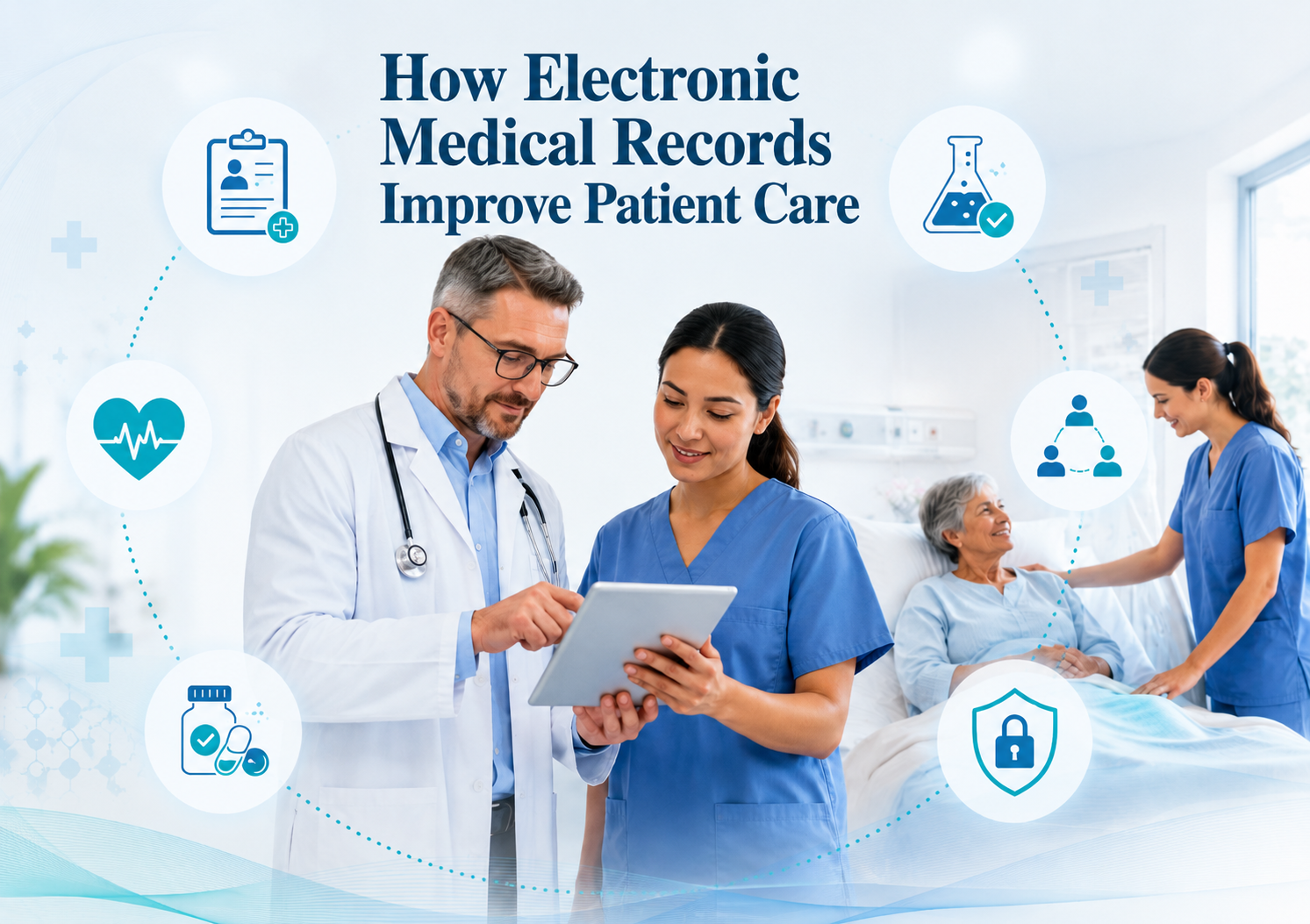
An EMR improves patient care through six connected mechanisms:
- It makes important information available at the point of care.
- It organizes clinical data into a more usable patient history.
- It connects orders, results, medications, and care activities.
- It supports reminders, warnings, and clinical decision support.
- It improves communication between authorized care-team members.
- It turns routine clinical documentation into data for quality improvement.
The technology itself does not treat the patient. It improves the information environment in which healthcare professionals make decisions.
1. Faster Access to Patient Information
An EMR gives clinicians immediate access to medical history, medicines, allergies, test results, and previous visits.
2. Faster and More Accurate Diagnosis
By showing abnormal results and health trends, an EMR helps clinicians detect problems and make informed diagnoses sooner.
3. Safer and More Personalized Treatment
An EMR helps clinicians select suitable treatments based on allergies, medicines, test results, existing conditions, and previous responses.
4. Improved Medication Safety and Fewer Errors
Electronic prescriptions, allergy warnings, interaction alerts, and accurate medication lists reduce prescribing and documentation errors.
5. Better Communication and Care Coordination
A shared record keeps doctors, nurses, pharmacists, laboratories, and other authorized teams updated on the patient’s current care plan.
6. Stronger Preventive and Chronic Care
Reminders, health trends, and follow-up tracking help clinicians manage long-term conditions and identify overdue screenings or treatments.
7. Faster and Safer Emergency Care
Emergency teams can quickly review allergies, medicines, medical conditions, and recent treatments when patients cannot provide their history.
8. Greater Patient Participation
Patient portals can help patients review results, medicines, appointments, instructions, and approved medical information.
9. More Efficient Clinical Workflows
EMRs automate orders, results, referrals, documentation, and follow-up tasks, reducing repeated work and administrative delays.
10. Better Reporting and Quality Improvement
Structured healthcare data helps hospitals identify care gaps, monitor outcomes, improve patient safety, and measure performance.
11. Earlier Identification of Patient Risks
Predictive tools can identify risks such as readmission or clinical deterioration, but healthcare professionals must review all recommendations.
Hidden Benefits Hospitals Discover After EMR Adoption
1. The hospital retains clinical knowledge
Paper-based care can depend heavily on individual memory. A structured record preserves the reasoning, actions, and outcomes of earlier care.
2. Repeat questions decrease
Patients may no longer need to repeat the same demographic, medication, and history information at every department, although important clinical details should still be confirmed.
3. Handover weaknesses become visible
Electronic workflows show where tasks remain incomplete, where results are pending, and where responsibility is unclear.
4. Clinical variation can be studied
Hospitals can compare how similar patients are assessed and treated, helping clinical leaders identify unexplained variation.
5. Documentation improves organizational learning
Incident reviews, audits, morbidity meetings, and quality projects have better evidence when the sequence of care is documented clearly.
6. Discharge planning can begin earlier
Pending investigations, medicines, referrals, and instructions can be tracked throughout the admission instead of being assembled only when the patient is ready to leave.
7. The organization can improve continuously
Once workflows are measurable, hospital management can test whether a new process actually improves safety, speed, or patient experience.
Common Myths About Electronic Medical Records
Myth 1: Digital information is always accurate
An EMR stores what users enter or what connected systems transmit. Incorrect data can still be recorded and reused.
Reality: Digital records require verification, data-quality monitoring, correction procedures, and clear information ownership.
Myth 2: More alerts mean safer care
Too many alerts can desensitize users.
Reality: High-value clinical decision support should be targeted, monitored, and refined.
Myth 3: An EMR automatically creates interoperability
Installing software does not guarantee meaningful information exchange.
Reality: Interoperability requires compatible standards, patient matching, terminology, interfaces, governance, security, and agreed workflows.
Myth 4: EMR implementation is an IT project
Technology teams are important, but they do not own clinical practice.
Reality: Implementation requires clinical leadership, nursing, pharmacy, diagnostics, administration, medical records, quality teams, and patient-safety oversight.
Myth 5: The paper process should simply be copied into the system
Some paper steps exist only because information was previously difficult to share.
Reality: Hospitals should redesign inefficient processes rather than digitizing every existing form and approval.
Myth 6: Once the system goes live, the work is finished
Clinical requirements, users, medicines, standards, and risks change.
Reality: EMR safety requires continuous monitoring, training, optimization, and governance.
EMR Implementation Mistakes That Can Harm Patient Care
- Failing to map real clinical workflows
- Creating duplicate or incorrect patient records
- Migrating outdated or inaccurate data
- Copying old notes into new encounters
- Using too many low-value alerts
- Skipping complete workflow and integration testing
- Providing the same training to every user role
- Operating without a downtime and recovery plan
- Failing to monitor and improve the system after launch
How to Choose the Right Electronic Medical Record System
Choose an EMR that supports patient safety, clinical workflows, integrations, security, and future growth.
- Match the system with actual patient-care workflows
- Test usability with doctors, nurses, and other staff
- Review medication and patient-identification controls
- Confirm laboratory, radiology, pharmacy, billing, and device integration
- Check security, privacy, backups, and data-export options
- Evaluate reporting, analytics, scalability, training, and support
- Request a complete workflow demonstration using real hospital scenarios
Hospital.Partners connects Electronic Medical Records with appointments, diagnostics, pharmacy, billing, inventory, and wider hospital operations, supporting a more coordinated patient journey.
FAQS
What is an Electronic Medical Record?
An Electronic Medical Record is a digital record of a patient’s medical history, diagnoses, medicines, allergies, test results, clinical notes, procedures, and treatment within a healthcare organization.
How does an Electronic Medical Record improve patient care?
It gives authorized healthcare providers faster access to accurate information, supports safer prescribing, improves care coordination, organizes clinical documentation, and enables reminders, follow-up, and quality reporting.
What is the difference between EMR and EHR?
An EMR traditionally focuses on records within one healthcare organization. An Electronic Health Record is designed to support a broader longitudinal record and information exchange across care settings. The terms are sometimes used interchangeably.
Can an EMR integrate with laboratory and radiology systems?
Yes, depending on the platform and interface capabilities. Integration can send electronic orders and return verified results to the patient record. Compatibility and workflow testing must be confirmed.
Conclusion
An Electronic Medical Record improves patient care when it gives healthcare professionals timely access to accurate, relevant, and well-organized patient information.
Its benefits extend beyond replacing paper. Electronic Medical Records can support faster diagnosis, safer prescribing, better treatment planning, coordinated teamwork, preventive care, chronic disease management, emergency decisions, patient participation, and hospital-wide quality improvement.
However, technology does not improve care by itself. Hospitals must protect data quality, design practical clinical workflows, reduce unnecessary alerts, train users, test integrations, maintain downtime procedures, measure outcomes, and treat EMR safety as an ongoing responsibility.
The next stage of digital healthcare transformation will not be defined by how much patient data hospitals collect. It will be defined by how safely, responsibly, and intelligently they use that data to support every patient decision.
For healthcare leaders, the central question is no longer whether medical records should become digital. It is whether the chosen system can turn digital patient information into safer, more coordinated, and more dependable care.