
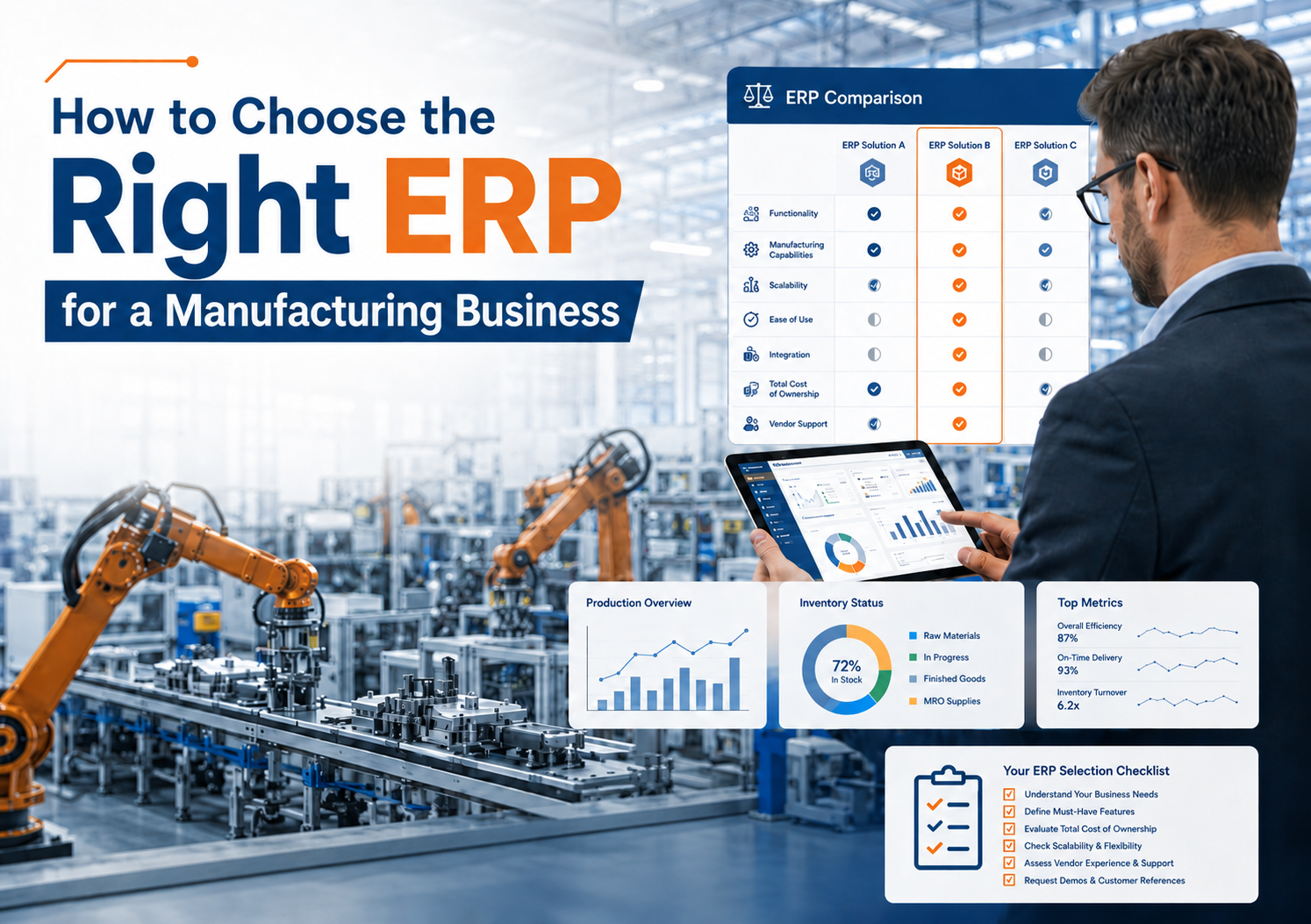
Manufacturing businesses today operate in an increasingly complex environment. Rising customer expectations, global supply chains, fluctuating raw material costs, inventory challenges, and increasing competition are compelling manufacturers to become more efficient, proactive and agile than ever before.
Many manufacturers still rely on disconnected systems, spreadsheets, and manual processes to manage production, inventory, procurement, finance, and sales. While these methods may work initially, they often become significant obstacles as businesses grow.
This is where Enterprise Resource Planning (ERP) systems play an unreplaceable role.
However, selecting the right ERP is not simply an IT decision it is a strategic business decision that can impact productivity, profitability, customer satisfaction, and long-term growth.
With dozens of ERP solutions available in the market, manufacturers often struggle to determine which system best fits their operational requirements. Understanding how to choose the right ERP for a manufacturing business requires careful evaluation of business needs, industry-specific capabilities, scalability, and implementation readiness.
This guide provides an ERP selection framework to help manufacturing companies make informed decisions and maximize their ERP investment.
What Is a Manufacturing ERP?
A Manufacturing ERP is an integrated business management system designed to help manufacturers manage and automate core business processes at a single platform.
Unlike generic business software, Financials.Partners – manufacturing ERP solution is specifically built to support production operations while connecting every department across the organization.
Core Functions of a Manufacturing ERP
A modern ERP for manufacturers typically includes:
- Production planning and scheduling
- MRP
- Inventory management
- Real-time Finished Goods
- Purchase and Payable
- Sales and Receivable management
- Financial management
- Reporting and analytics
How ERP Connects Manufacturing Operations
One of the biggest advantages of ERP software for manufacturing companies is centralized data.
Instead of departments working in silos, ERP creates a single source of truth across:
| Department | ERP Function |
| Production | Planning, scheduling, MRP, Purchase Orders & work orders, |
| Inventory | Stock control and tracking |
| Finance | Accounting, budgeting, cost analysis |
| Sales | Order management and customer information |
This integration improves visibility, reduces errors, and supports faster decision-making.
Why Choosing the Right ERP Matters?
Not all ERP systems are created equal.
Selecting an ERP that aligns with your manufacturing processes can significantly improve business performance, while choosing the wrong system can lead to implementation failures, budget overruns, and operational disruptions.
Improved Productivity
Automation reduces repetitive tasks and manual data entry, allowing employees to focus on higher-value activities.
Better Cost Control
Manufacturers gain better visibility into:
- Production costs
- Material costs
- Labor expenses
- Inventory carrying costs
This helps identify inefficiencies and improve profitability.
Inventory Optimization
An Inventory Management ERP helps organizations:
- Reduce excess inventory
- Prevent stock outs
- Improve inventory accuracy
- Optimize warehouse space
Enhanced Production Efficiency
Accurate production planning software enables businesses to:
- Improve scheduling
- Minimize downtime
- Increase throughput
- Meet delivery deadlines
Better Decision-Making
Real-time dashboards and reporting provide management with actionable insights instead of relying on outdated spreadsheets.
Scalability
The right ERP supports future growth without requiring businesses to replace systems as operations expand.
9 Key Factors to Consider When Choosing a Manufacturing ERP
1. Industry-Specific Manufacturing Features
Why It Matters
Manufacturing businesses have unique requirements that generic ERP systems often fail to address.
Industry-specific functionality may include:
- Bill of Materials (BOM)
- Production orders
- Material requirements planning (MRP)
- Quality control
Common Mistakes
- Choosing a generic ERP without manufacturing modules
- Assuming all ERP systems offer the same capabilities
What to Evaluate
Ask vendors whether the system supports:
- Discrete manufacturing
- Process manufacturing
- Make-to-order operations
- Make-to-stock operations
2. Production Planning and Scheduling Capabilities
Why It Matters
Production planning software helps optimize resource utilization and production efficiency.
Strong planning capabilities allow manufacturers to:
- Schedule work orders
- Allocate resources
- Manage capacity
- Meet customer deadlines
Common Mistakes
- Relying on spreadsheets for scheduling
- Ignoring capacity planning requirements
What to Evaluate
Look for:
- Finite capacity scheduling
- MRP functionality
- Work center management
- Production forecasting
3. Inventory Management
Why It Matters
Inventory often represents one of the largest investments for manufacturers.
An effective inventory management ERP can reduce carrying costs while maintaining service levels.
Common Mistakes
- Selecting systems with limited inventory visibility
- Ignoring warehouse management requirements
What to Evaluate
Key features include:
- Real-time inventory tracking
- Batch and lot tracking
- Barcode support
- Inventory forecasting
4. Real-Time Reporting and Analytics
Why It Matters
Data-driven organizations outperform competitors because they make faster and better decisions.
Common Mistakes
- Depending on static reports
- Lacking visibility into key KPIs
What to Evaluate
Ensure the ERP provides:
- Real-time dashboards
- Production metrics
- Financial reports
- Inventory analytics
5. Scalability for Future Growth
Why It Matters
Your ERP should support business growth over the next five to ten years.
Common Mistakes
- Selecting ERP solely for current requirements
- Ignoring future expansion plans
What to Evaluate
Consider:
- Multi-location support
- Additional user capacity
- New product lines
- International operations
6. Ease of Use and User Adoption
Why It Matters
Even the most powerful ERP system can fail if employees struggle to use it.
Common Mistakes
- Prioritizing functionality over usability
- Underestimating training requirements
What to Evaluate
Assess:
- User interface design
- Navigation simplicity
- Mobile accessibility
- Training resources
7. Integration with Existing Systems
Why It Matters
Most manufacturers already use various software solutions.
ERP should integrate seamlessly with:
- CRM systems
- E-commerce platforms
- Payroll software
- Shop floor equipment
- Business intelligence tools
Common Mistakes
- Ignoring integration requirements
- Creating data silos
What to Evaluate
Ask vendors about:
- APIs
- Integration frameworks
- Existing connectors
- Data migration support
8. Customization and Flexibility
Why It Matters
Every manufacturing business has unique workflows.
Common Mistakes
- Over-customizing the system
- Choosing rigid software
What to Evaluate
Look for:
- Workflow configuration
- Custom fields
- Process automation
- Role-based access controls
9. Vendor Support and Implementation Expertise
Why It Matters
ERP implementation is often more important than the software itself.
Common Mistakes
- Evaluating software only
- Ignoring implementation methodology
What to Evaluate
Review:
- Industry experience
- Customer references
- Support availability
- Training programs
- Implementation timeline
Questions to Ask ERP Vendors Before Making a Decision
Before selecting an ERP solution, manufacturers should ask vendors the following questions:
- Do you have experience working with manufacturing companies similar to ours?
- Which manufacturing-specific features are included?
- How does your system support production planning and scheduling?
- What inventory management capabilities are available?
- Can the ERP integrate with our existing software?
- What implementation methodology do you follow?
- How long does implementation typically take?
- What training resources are provided?
- How scalable is the system for future growth?
- What level of post-implementation support is included?
- What reporting and analytics tools are available?
- Can you provide customer references from manufacturing clients?
Common ERP Selection Mistakes Manufacturers Should Avoid
Avoiding these common mistakes can dramatically improve ERP project success.
Choosing Based Only on Price
The lowest-cost ERP may lack critical functionality and create higher long-term costs.
Ignoring Future Growth Requirements
Choose software that supports future expansion rather than current needs alone.
Overlooking User Adoption
Employee resistance can derail implementation efforts.
Not Involving Key Departments
Successful ERP selection requires input from:
- Production
- Inventory
- Finance
- Sales
- Operations
Underestimating Implementation Requirements
ERP implementation involves:
- Process mapping
- Data migration
- Training
- Change management
Failing to Define Business Objectives
Clear goals help measure ERP success and guide vendor selection.
ERP Selection Checklist
Use this checklist during ERP evaluations:
Business Requirements
- Define business goals
- Document current challenges
- Identify future growth plans
Manufacturing Capabilities
- Production planning
- MRP functionality
- Quality management
- Shop floor visibility
Inventory Management
- Real-time inventory tracking
- Warehouse management
- Batch tracking
Financial Management
- General ledger
- Cost accounting
- Budgeting
- Financial reporting
Technology
- Cloud or on-premise deployment
- Integration capabilities
- Mobile access
Vendor Evaluation
- Industry expertise
- Customer references
- Implementation methodology
- Training resources
- Support services
Scalability
- Multi-site support
- User expansion
- International capabilities
How Modern Manufacturing ERP Solutions Drive Digital Transformation
Digital transformation is reshaping the manufacturing industry.
Modern ERP solutions serve as the foundation for this transformation by connecting people, processes, and data across the organization.
Automation
ERP automates repetitive tasks such as:
- Purchase order creation
- Inventory updates
- Financial transactions
- Production scheduling
This reduces errors and improves efficiency.
Real-Time Visibility
Executives gain immediate access to operational and financial data.
Benefits include:
- Faster response times
- Better forecasting
- Improved customer service
Data-Driven Decisions
ERP systems transform raw data into actionable insights that support strategic decision-making.
Operational Efficiency
Integrated workflows eliminate duplication and improve collaboration across departments.
Competitive Advantage
Organizations that leverage ERP effectively can:
- Scale efficiently
- Respond faster to market changes
- Improve customer satisfaction
- Reduce operational costs
Conclusion
Choosing the right ERP for a manufacturing business is one of the most important strategic decisions an organization can make. The right solution can improve production efficiency, optimize inventory, strengthen financial control, enhance supply chain visibility, and provide the scalability needed for future growth.
Successful ERP selection requires more than comparing software features. Manufacturers should evaluate industry-specific functionality, implementation expertise, integration capabilities, usability, reporting tools, and long-term business alignment.
By following a structured ERP selection guide and involving key stakeholders throughout the process, manufacturers can significantly improve their chances of achieving a successful ERP implementation and realizing long-term business value.
As manufacturing organizations continue their digital transformation journeys, modern ERP solutions such as Financials.Partners provide an integrated platform that helps manufacturing and trading businesses streamline operations, improve visibility across departments, and support sustainable growth through data-driven decision-making.