
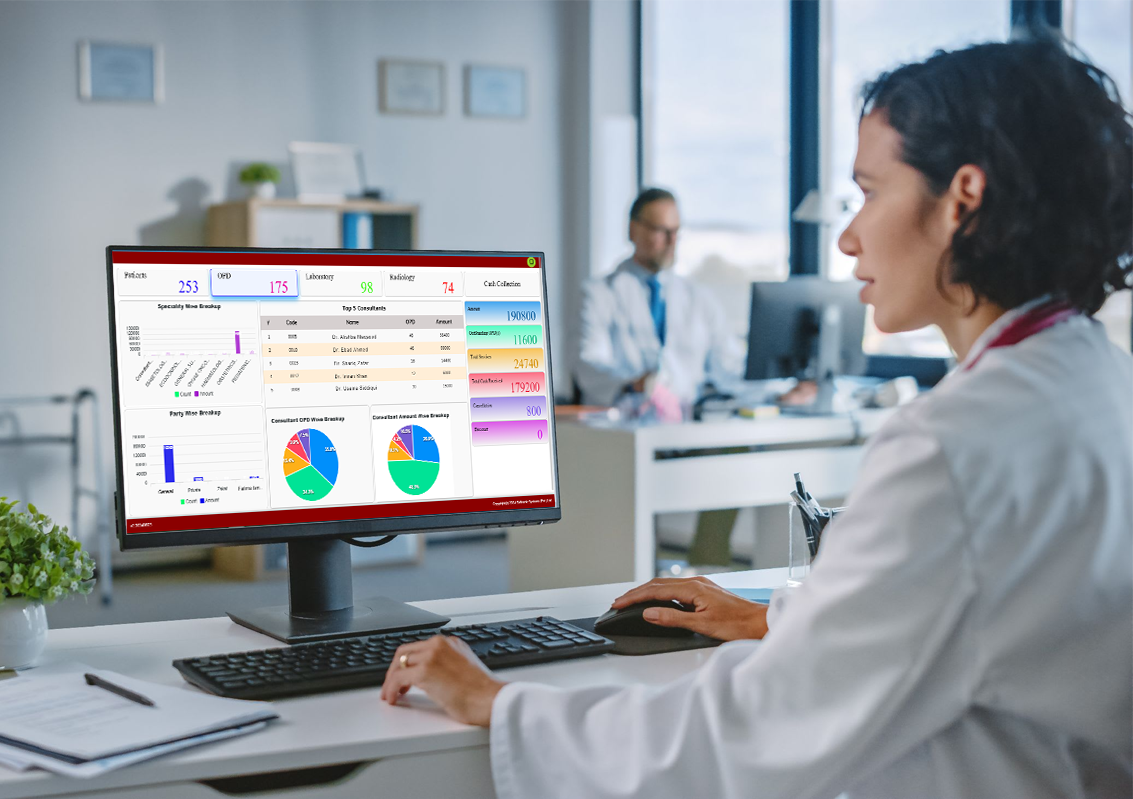
Finding the best clinic management software in Pakistan is not simply about choosing the system with the longest list of features. The right software should fit your clinic’s workflow, make everyday administration easier, help organize important information, and provide the level of support your team needs.
Before choosing a solution, clinic owners and administrators should compare software based on practical requirements such as usability, patient record management, financial processes, reporting, implementation, scalability, and vendor support.
This guide explains what to compare when evaluating clinic management software in Pakistan and what to consider before making a purchase.
What Makes Clinic Management Software the Right Choice?
Every clinic operates differently.
A single-doctor practice, a multi-consultant clinic, and a larger healthcare facility may have very different requirements. Therefore, the “best” software is the one that fits the organization’s actual workflow rather than the one with the most features.
Before comparing vendors, identify:
- How many patients your clinic handles
- How many doctors or consultants use the system
- How patient registration is currently managed
- How patient information is stored
- How payments and receipts are handled
- What reports management needs
- What administrative tasks consume the most time
- What support your staff will require
Once these requirements are clear, comparing different software solutions becomes much easier.
8 Things to Compare Before Choosing Clinic Software in Pakistan
1. Does It Match Your Clinic’s Workflow?
The first question should be simple:
Can the software support the way your clinic actually works?
Avoid choosing software based only on a demonstration or feature list. Ask the vendor to show how the system handles the processes your staff perform every day.
For example, you may want to see how the software handles:
- Registering a new patient
- Finding an existing patient
- Managing patient information
- Recording payments
- Generating receipts
- Reviewing operational information
- Tracking consultant-related revenue
A system that fits naturally into your workflow is more likely to be adopted successfully by your staff.
2. How Well Does It Handle Patient Information?
Patient information is one of the most important assets managed by a clinic.
When comparing software, look at how easily authorized staff can organize and retrieve patient information.
Consider:
- Patient registration
- Patient history
- Previous treatments
- Medical information
- Family history
- Allergies
- Medication information
- Record retrieval
Also ask the provider how patient information is protected and what access controls are available.
Healthcare organizations should evaluate software according to their own privacy, security, legal, and regulatory requirements.
3. Can It Simplify Payments and Financial Administration?
Financial processes are another area where manual work can create unnecessary administrative effort.
When evaluating software, ask how it handles:
- Patient payments
- Payment receipts
- Billing records
- Transaction information
- Financial reporting
- Consultant-related revenue
Don’t just ask whether a feature exists.
Ask the vendor to demonstrate the complete process from recording a payment to retrieving the relevant information later.
4. Can Management Understand Clinic Activity?
Software should provide more than digital record storage.
Management may also need to understand how the clinic is performing operationally.
Patient turnover information, for example, can help management understand activity across different periods.
Ask whether the software can help you analyze information such as:
- Daily patient activity
- Weekly patient activity
- Monthly patient activity
- Patient turnover
- Consultant revenue
The specific reports required will depend on the clinic’s management and reporting needs.
5. Is It Easy for Staff to Use?
A sophisticated system is not useful if staff struggle to use it.
When evaluating a solution, consider:
How many steps does it take to complete common tasks?
Ask staff members who will actually use the software to participate in the evaluation.
A practical demonstration should answer questions such as:
- Is registration straightforward?
- Can staff find patient information quickly?
- Are common tasks easy to understand?
- Is training required?
- How long might new staff take to learn the system?
Usability should be considered alongside functionality.
6. What Support Does the Vendor Provide?
Choosing software is also choosing a long-term technology partner.
Before purchasing, ask:
- Who provides implementation assistance?
- Is staff training available?
- How can technical problems be reported?
- What type of ongoing support is provided?
- Who will be responsible for troubleshooting?
- How are software updates handled?
For clinics in Pakistan, having access to a provider familiar with the local healthcare environment can also be an important consideration.
7. Can the Software Grow With Your Clinic?
Your requirements today may not be the same in the future.
Consider whether the solution can continue to support your organization if you:
- Add consultants
- Increase patient volume
- Expand administrative operations
- Introduce additional workflows
- Need more reporting
Choosing software with your future requirements in mind can reduce the need for another major system change later.
8. What Is the Total Cost of Ownership?
Price should not be the only factor when comparing clinic management software.
Consider the complete cost of adopting and maintaining the solution, including:
- Software costs
- Implementation
- Training
- Support
- Maintenance
- Additional users or requirements
- Future upgrades
A cheaper solution is not necessarily better if it creates more administrative work or lacks the support your clinic needs.
Clinic Management Software Comparison Checklist
Before making a decision, use this checklist when evaluating different solutions.
| What to compare | Questions to ask |
| Workflow | Does the software fit our existing processes? |
| Patient records | Can staff organize and retrieve patient information efficiently? |
| Payments | Can payments and receipts be managed easily? |
| Reporting | Does it provide the information management needs? |
| Patient activity | Can we monitor patient turnover? |
| Consultant management | Can relevant consultant revenue be tracked? |
| Usability | Can staff learn the system without unnecessary complexity? |
| Support | What assistance is available after implementation? |
| Scalability | Can the system support future growth? |
| Cost | What is the total cost of ownership? |
This checklist can help prevent a common mistake: selecting software based on marketing claims instead of actual clinic requirements.
Common Mistakes When Choosing Clinic Management Software
Choosing software based only on price or the number of features can lead to problems later.
Here are some mistakes worth avoiding.
Choosing the Cheapest Option
The lowest initial price does not necessarily mean the lowest overall cost.
Consider implementation, training, support, maintenance, and the amount of administrative work the system can actually save.
Choosing Too Many Features
More features do not automatically make software better.
Unused features can make a system harder to understand and more difficult for staff to adopt.
Focus on the functions your clinic actually needs.
Ignoring Staff Feedback
The people using the software every day should be involved in the evaluation.
A system that looks impressive to management may still be inconvenient for reception staff, administrators, or other users.
Not Asking About Support
Software problems can affect daily operations.
Before purchasing, make sure you understand what support is available and how quickly your team can get assistance.
Skipping the Demonstration
Never rely entirely on screenshots or feature lists.
Ask the provider to demonstrate the actual workflows that matter to your clinic.
Hospital.Partners for Clinics in Pakistan
Hospital.Partners, developed by Softronic Systems (Pvt.) Ltd., is a healthcare management solution that can be evaluated by clinics looking to digitize important administrative and operational processes.
Its clinic-related functionality includes areas such as:
- Patient registration
- Patient history management
- Payment receipts
- Patient turnover tracking
- Consultant revenue management
Hospital.Partners has been implemented and used at hospitals and clinics in Karachi and Pakistan.
The right approach is to compare these capabilities against your own clinic’s requirements rather than assuming that every clinic needs the same solution.
Final Checklist Before You Choose Best Clinic Management Software in Pakistan
Before selecting your clinic management software, make sure you can answer “yes” to these questions:
- Does the software fit our clinic’s workflow?
- Can our staff use it comfortably?
- Can we manage the patient information we need?
- Can we manage payments and receipts effectively?
- Can management access useful operational information?
- Can relevant consultant revenue be tracked?
- Is implementation practical?
- Is adequate vendor support available?
- Can the system accommodate future requirements?
- Does the overall cost make sense for our clinic?
If the answer is yes, you are much closer to finding the right solution for your practice.
FAQS
What is the best clinic management software in Pakistan?
The best clinic management software in Pakistan like Hospital.Partners helps manage patient records, billing, and clinic operations efficiently.
Can clinic software track patient history?
Yes. Modern systems store complete patient history, including treatments and medical records.
How does clinic software help in revenue management?
It tracks payments, generates receipts, and monitors consultant revenue, ensuring financial transparency.
Looking for the Best Clinic Management Software in Pakistan?
If you are comparing solutions for your clinic, the next step is to evaluate the software against your actual workflow.
Contact Softronic Systems to discuss your requirements and request a Hospital.Partners demonstration.