
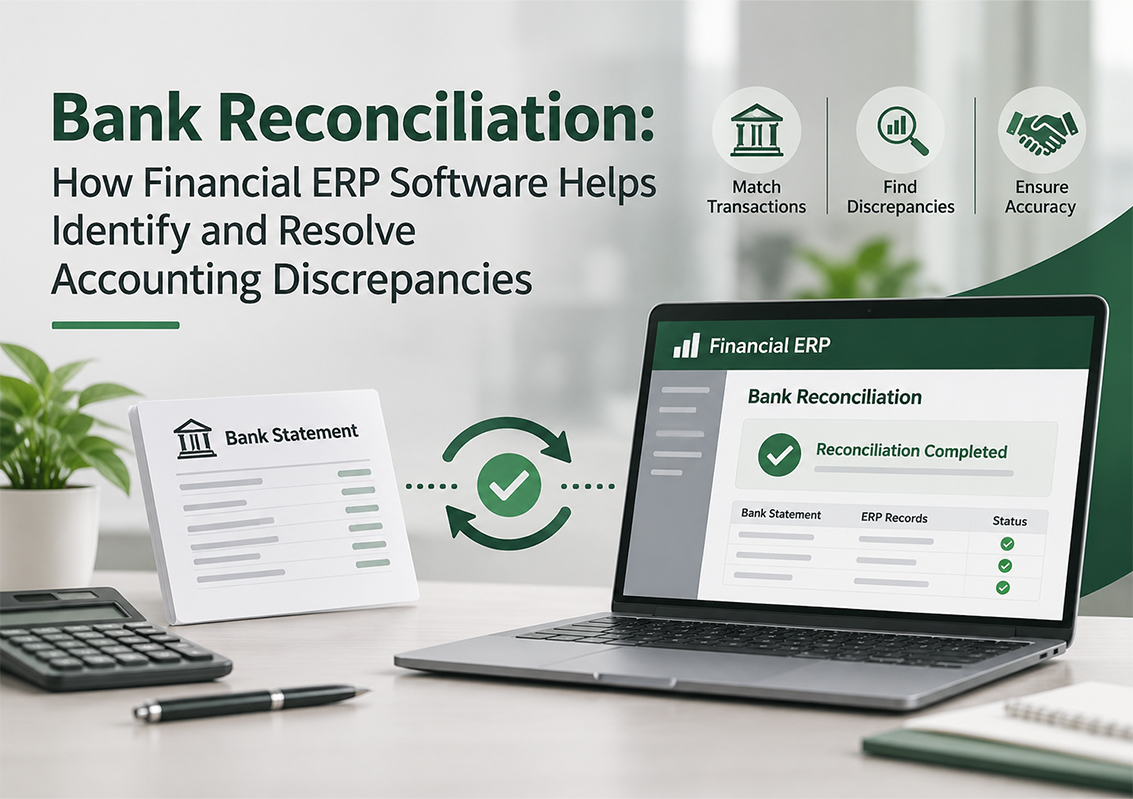
Bank reconciliation is an essential accounting process that helps businesses ensure their financial records accurately reflect their banking transactions. It involves comparing the transactions recorded in a company’s accounting books with those appearing on its bank statement to identify and resolve differences.
For businesses managing multiple financial transactions, maintaining accurate bank records can become challenging. Unrecorded bank charges, duplicate entries, payment delays, and transaction errors can create discrepancies that affect financial reporting and cash flow visibility.
A systematic bank reconciliation process helps businesses identify these issues, correct accounting records, and maintain better financial control. With Financial ERP Software like Financials.Partners, businesses can also simplify reconciliation through automatic adjustments for discrepancies.
What Is Bank Reconciliation?
Bank reconciliation is the process of comparing a company’s cash or bank account records in its accounting system with the corresponding bank statement for a specific period.
The purpose is to verify that both records reflect the same financial activity and identify transactions that explain any differences.
For example, a business may record a supplier payment in its accounting system, but the payment might not appear on the bank statement until the following business day. Similarly, a bank may deduct service charges that have not yet been recorded in the company’s books.
These differences do not necessarily indicate accounting errors. Some occur because transactions are recorded at different times, while others may result from missing entries or incorrect amounts.
Regular bank reconciliation helps finance teams distinguish between timing differences and genuine accounting discrepancies.
Why Is Bank Reconciliation Important for Businesses?
Accurate financial records are essential for effective business management. Bank reconciliation helps organizations maintain reliable accounting information and identify potential financial issues before they affect business operations.
Here are some important benefits:
1. Improves Financial Record Accuracy
Comparing bank statements with accounting records helps identify missing transactions, duplicate entries, and incorrect amounts. Correcting these differences improves the reliability of financial information.
2. Helps Detect Unauthorized Transactions
Regular reconciliation can help businesses identify unfamiliar withdrawals, unexpected payments, or transactions that require further investigation.
3. Supports Better Cash Flow Management
Accurate bank balances help management understand available funds, monitor outgoing payments, and make better financial decisions.
4. Strengthens Internal Financial Controls
A consistent reconciliation process creates an additional layer of financial oversight. It also supports better documentation and accountability within the finance department.
5. Improves Financial Reporting
Accurate bank records contribute to reliable cash balances in the general ledger, trial balance, and financial statements.
Common Causes of Bank Reconciliation Discrepancies
Bank reconciliation discrepancies occur when the balance or transactions in accounting records do not match the corresponding bank statement.
Understanding their causes makes it easier to investigate and resolve differences.
1. Outstanding Cheques and Payments
A business may issue a cheque or initiate a payment that has been recorded in its accounting system but has not yet been processed by the bank.
This creates a timing difference between the two records.
2. Deposits in Transit
Deposits in transit occur when a business records a deposit in its books, but the bank has not yet reflected it in the bank statement.
These differences are generally resolved when the bank processes the deposit.
3. Unrecorded Bank Charges
Banks may deduct service fees, transaction charges, maintenance fees, or other banking expenses directly from a business account.
If these charges are not recorded in the accounting system, the book balance will differ from the bank balance.
4. Duplicate or Incorrect Entries
Entering the same transaction more than once or recording an incorrect amount can create discrepancies.
For example, recording a supplier payment of PKR 150,000 as PKR 155,000 creates a difference of PKR 5,000.
5. Direct Deposits and Bank Credits
Customers or other parties may deposit money directly into a business bank account without immediately notifying the accounting department.
Until the transaction is recorded in the books, the two balances may not match.
6. Data Entry and Transaction Recording Errors
Incorrect transaction dates, amounts, account selections, or posting errors can affect the accuracy of accounting records.
These errors require investigation and appropriate corrections.
Benefits of Using Financials.Partners for Bank Reconciliation
Managing bank reconciliation manually can become increasingly difficult as transaction volumes grow.
Businesses may need to review hundreds or thousands of transactions, maintain supporting documents, investigate discrepancies, and update accounting records.
Financials.Partners helps simplify financial management by bringing accounting transactions, ledger records, and reporting capabilities together.
Some important benefits include:
Reduced Manual Effort
Financials.Partners can simplify reconciliation activities and reduce the effort required to review and manage accounting discrepancies.
Better Financial Accuracy
Maintaining structured accounting records helps finance teams identify missing entries, incorrect postings, and other inconsistencies.
Faster Discrepancy Management
Software-supported reconciliation makes it easier to review differences and manage the necessary accounting adjustments.
Improved Financial Visibility
Access to ledger information, trial balances, and financial statements helps management understand the impact of accounting transactions.
Stronger Accounting Controls
Features such as audit trails and posting controls support better financial accountability and transaction management.
Simplify Bank Reconciliation with Financials.Partners
As businesses grow, managing financial transactions and maintaining accurate accounting records becomes increasingly important.
Financials.Partners offers an integrated Financial Accounts with Report Writer module designed to support business accounting, financial reporting, and transaction management.
Its bank reconciliation functionality helps simplify the reconciliation process through automatic adjustments for discrepancies.
In addition to bank reconciliation, the module provides several financial management capabilities:
Simplified Bank Reconciliation
Businesses can use the bank reconciliation functionality to support the review and management of differences between accounting records and bank transactions.
Automatic adjustments for discrepancies help simplify the reconciliation process.
Comprehensive Voucher Management
Voucher management capabilities support the recording and management of financial transactions, with audit trails, electronic signatures, and posting/unposting controls.
Flexible Chart of Accounts
The system supports a flexible chart of accounts with up to five user-defined levels, helping businesses categorize assets, liabilities, capital, revenue, and expenses.
Real-Time Financial Reporting
The dynamic report writer supports the generation of important financial reports, including:
- General ledger
- Trial balance
- Profit and loss statement
- Balance sheet
Cost Centre and Department-Wise Expense Tracking
Businesses can monitor expenses through cost centers, sub-cost centers, and department-based tracking without unnecessarily expanding the chart of accounts.
Budget Monitoring
Budgeting capabilities support budget allocation and comparison of actual expenses against planned amounts, helping management monitor financial performance.
By bringing these capabilities together, Financials.Partners helps businesses manage financial accounting processes, improve transaction visibility, and support more organized financial operations.
Best Practices for Effective Bank Reconciliation
Businesses can improve reconciliation accuracy by following a few essential practices:
- Reconcile bank accounts regularly: Perform reconciliation monthly or more frequently when transaction volumes are high.
- Maintain accurate accounting records: Record financial transactions promptly and verify supporting documentation.
- Investigate discrepancies promptly: Avoid carrying unexplained differences from one reconciliation period to another.
- Review unusual transactions: Investigate unfamiliar payments, unexpected deposits, and duplicate entries.
- Maintain supporting documents: Keep bank statements, payment records, receipts, and adjustment details.
- Establish approval controls: Define responsibilities for reviewing and approving accounting adjustments.
- Use accounting software: Adopt a suitable financial management system to simplify reconciliation and improve financial reporting.
Conclusion
Bank reconciliation is an important part of maintaining accurate financial records and effective business financial control. By regularly comparing bank statements with accounting records, businesses can identify discrepancies, investigate transaction differences, and maintain reliable financial information.
Although manual reconciliation may work for businesses with limited transactions, growing organizations often need more structured accounting processes and software-supported financial management.
Financials.Partners helps simplify bank reconciliation through automatic adjustments for discrepancies while providing integrated accounting, voucher management, budgeting, and financial reporting capabilities.
Explore Financials.Partners by Softronic Systems (Pvt.) Ltd. to discover how integrated financial management can help streamline your accounting operations and support better financial control.