
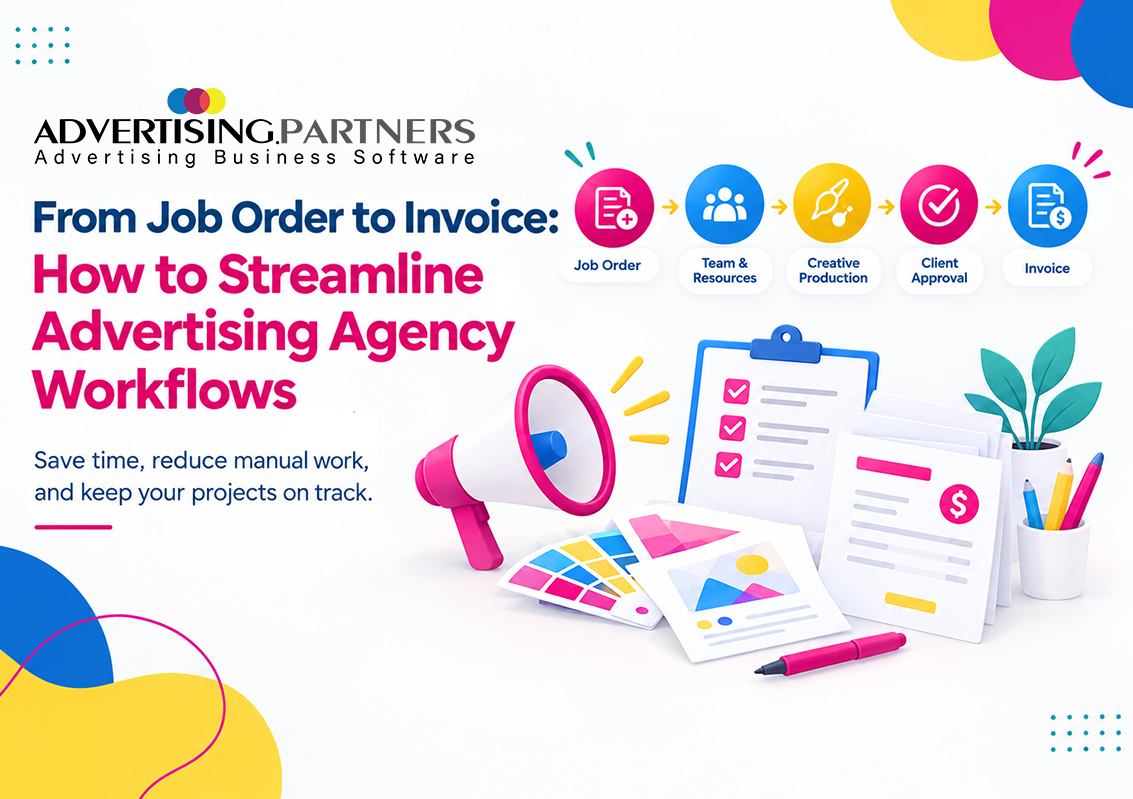
Advertising agencies manage much more than creative campaigns. Every project involves client requirements, job orders, cost estimates, approvals, media planning, vendor coordination, campaign monitoring, billing, and payment follow-ups. When these activities are handled through separate spreadsheets, emails, messaging apps, and accounting systems, even a routine campaign can become difficult to manage.
For advertising agencies in Pakistan, improving operational efficiency means creating a clear connection between every stage of a project. Teams need to know what has been requested, what has been approved, what has been executed, and what still needs to be billed or collected.
This is where advertising agency workflow management becomes important. With the right processes and integrated software, agencies can improve coordination, maintain more consistent records, and gain better visibility into project costs and financial performance.
Why Advertising Agency Workflows Need Smart Management
A typical advertising project involves several departments and external stakeholders. An account manager may receive a client brief, the creative team may prepare the artwork, the finance team may calculate costs, and the media department may coordinate placements with publishers or other vendors.
Each department depends on accurate information from the previous stage. If an estimate is revised but the media team uses an outdated version, delays and cost discrepancies can follow. If campaign execution is completed but the finance team is not informed, invoicing may be delayed.
Common workflow problems include:
- Job requests getting lost among emails and messages.
- Estimates waiting too long for approval.
- Teams working with outdated project information.
- Media release orders not being tracked consistently.
- Vendor bills and client invoices being managed separately.
- Completed jobs remaining unbilled.
- Management lacking a clear view of outstanding payments and project costs.
An organized workflow connects these activities and gives each team a clearer picture of the project’s status.
Step 1: Start Every Project with a Structured Job Order
The job order is the starting point of an organized advertising workflow. It records what the client needs and provides a reference for the activities that follow.
Depending on the project, a job order may cover creative artwork, print production, television or radio advertising, outdoor placements, events, or other media-related services.
A structured job order should capture relevant client details, project requirements, deadlines, assigned responsibilities, and supporting information.
Without a consistent starting point, teams may rely on verbal instructions or scattered messages. This makes it harder to establish responsibility, track progress, and connect the completed work to its associated costs.
How Advertising.Partners helps: Advertising.Partners centralizes job information so authorized teams can refer to a consistent record throughout the project lifecycle.
Step 2: Prepare Estimates and Secure Client Approvals
Once the requirements are understood, the agency prepares an estimate outlining the proposed services, media costs, production expenses, and other applicable charges.
Estimates are important because they establish the commercial basis for the work. Changes in scope, quantities, or media selection may require revisions before execution begins.
Manual approval processes can create bottlenecks. An estimate may remain in an inbox, a team member may use an outdated version, or work may proceed before the required approval is documented.
An organized estimation workflow should make it easier to identify the current estimate, track its status, and maintain a record of relevant revisions and approvals.
How Advertising.Partners helps: Integrated estimate management connects estimates with job orders and helps teams track approval status. This improves visibility and supports better control over the transition from planning to execution.
Step 3: Coordinate Media Release Orders and Campaign Execution
After the necessary approvals are secured, the agency can coordinate the approved media activity with the relevant suppliers, publishers, channels, or other service providers.
Release orders help formalize these arrangements. They can contain relevant media details, schedules, quantities, rates, and supplier information, depending on the agency’s workflow.
For agencies working across print, electronic, outdoor, and other media, managing these activities separately can make it difficult to establish which placements have been authorized and what remains to be executed.
A disconnected process also creates a risk of discrepancies between the approved estimate, the release order, and the supplier’s eventual bill.
How Advertising.Partners helps: Advertising.Partners can connect release orders with the relevant job and estimate records, helping teams maintain better coordination and traceability across campaign activities.
Step 4: Monitor Campaign Execution and Record Discrepancies
Issuing a release order is not necessarily the end of the media team’s responsibility. Agencies may also need to monitor whether booked activities were executed as planned and document any discrepancies.
For example, a publication placement may not appear as scheduled, a campaign may run for fewer days than agreed, or another variation may require follow-up.
These situations can affect client reporting, vendor reconciliation, and billing. If monitoring records are maintained separately from campaign and financial information, the agency may struggle to resolve discrepancies efficiently.
A structured monitoring process helps teams record relevant execution details, retain supporting evidence where applicable, and identify matters requiring attention.
How Advertising.Partners helps: Media monitoring and droppage management capabilities help agencies maintain organized monitoring records and connect relevant discrepancies with the wider campaign workflow.
Step 5: Match Vendor Bills with the Work Performed
Advertising agencies frequently coordinate with external suppliers, including media organizations, printers, production companies, outdoor media providers, and event vendors.
Their invoices need to be reviewed against the relevant work and commercial arrangements. Differences in rates, quantities, dates, or executed activity may need to be investigated before a bill is finalized.
When vendor billing operates independently of job orders and release orders, finance teams may spend unnecessary time requesting documents and confirming details with other departments.
An organized process gives finance teams a clearer basis for reviewing supplier charges and recording outstanding liabilities.
How Advertising.Partners helps: Integrated vendor billing and financial records help agencies organize supplier bills, monitor payables, and maintain a clearer connection between operational activities and financial obligations.
Step 6: Generate Client Invoices Without Losing Track of Completed Work
A completed campaign still needs to be billed accurately and on time. However, invoicing can be delayed when finance teams do not have timely information about approved work, media execution, applicable adjustments, or supplier costs.
Unbilled work can affect cash flow and make it difficult for management to understand the agency’s current financial position.
Agencies should establish a consistent handover from project execution to invoicing. Relevant job records, approved estimates, release orders, monitoring information, and agreed adjustments should be reviewed before the invoice is finalized.
The precise process will depend on the services delivered and the agency’s billing arrangements.
How Advertising.Partners helps: It can connect operational records with client invoicing workflows. This reduces reliance on manual information gathering and makes it easier to identify billing items that require attention.
Step 7: Connect Invoices, Payments, and Financial Reporting
The workflow does not end when an invoice is issued. Agencies must also track receipts, outstanding client balances, vendor payments, and the financial position of the business.
When operational and accounting records are disconnected, management may struggle to answer important questions:
- Which client invoices remain outstanding?
- Which supplier payments are due?
- How much does each client owe?
- Which jobs have unresolved billing or cost discrepancies?
- What is the current position of receivables and payables?
These questions become more difficult to answer as the number of clients, campaigns, and vendors grows.
An integrated financial process connects transactions with customer and supplier accounts and provides a more consistent basis for reporting.
How Advertising.Partners helps: Integrated financial accounting supports access to customer and creditor ledgers, receivables, payables, aging information, and other relevant financial reports. This helps management make decisions using more connected operational and financial information.
The Role of Integrated Advertising Agency Workflow Management Software
Managing each stage efficiently is important, but the greater benefit comes from connecting the stages.
Consider the complete workflow:
Client request → Job order → Estimate → Approval → Release order → Media monitoring → Vendor bill → Client invoice → Payment tracking → Financial reporting
When each stage is linked to the relevant records, teams can reduce repetitive information gathering and improve visibility across departments.
Instead of relying on separate systems to track project execution and financial transactions, agencies can work towards a more coordinated process.
When evaluating advertising agency workflow management software, look for capabilities that support:
- Job order and project tracking.
- Estimate preparation and approval workflows.
- Media release order management.
- Campaign monitoring and droppage records.
- Client invoicing and vendor billing.
- Integrated financial accounts.
- Receivables, payables, and aging reports.
- Management dashboards and operational reporting.
The right solution should support the agency’s actual processes rather than introduce unnecessary complexity.
How Advertising.Partners Helps Connect Agency Operations
Advertising.Partners by Softronic Systems is an integrated ERP solution designed for advertising and media agencies. It brings together project management, media-related workflows, billing, and financial accounting on a single platform.
Its capabilities include job orders, estimates, release orders, media monitoring, client invoicing, vendor billing, and financial accounts.
By connecting these functions, Advertising.Partners helps agencies organize operational records, improve visibility into outstanding receivables and payables, and access customer and creditor ledger information.
For agencies looking to move beyond disconnected spreadsheets and separate operational systems, this integrated approach provides a foundation for more structured job management and financial control.
The practical starting point is to examine your current workflow, identify where information gets delayed, and determine which processes would benefit most from greater integration.
Explore Advertising.Partners to learn more about its advertising agency ERP capabilities.
Frequently Asked Questions
What is advertising agency workflow management?
Advertising agency workflow management is the process of organizing and coordinating the activities involved in delivering advertising projects, from client requests and estimates to campaign execution, billing, and financial reporting.
How can ERP software improve advertising agency billing?
An integrated ERP like Advertising.Partners can connect job records, estimates, release orders, relevant monitoring information, invoices, and financial accounts. This helps teams access the information needed to review billing and track outstanding balances.
Conclusion: Build a More Connected Advertising Workflow
From the first client request to the final invoice, every stage of an advertising project depends on accurate information and effective coordination.
Disconnected workflows can lead to approval delays, incomplete monitoring records, billing backlogs, and limited financial visibility. A more structured process helps agencies keep projects organized and gives management a clearer view of operational and financial activities.
By connecting job orders, estimates, release orders, media monitoring, billing, and financial accounting, advertising agencies can establish a more consistent foundation for managing their work.
Want to streamline your agency’s workflow from job order to invoice?
Discover how Advertising.Partners can help your team connect advertising operations and financial management.
Explore Advertising.Partners or contact Softronic Systems at solutions@softronicsys.com to discuss your requirements and request a demo.