

Choosing the best advertising management software for your agency is not just an IT decision. It is an operational decision that affects job orders, estimates, approvals, media release orders, vendor bills, client invoices, campaign monitoring, receivables, reporting, and profitability.
Advertising agencies handle fast-moving work. A single campaign may involve creative teams, media planners, account managers, finance teams, vendors, clients, publications, channels, digital platforms, and outdoor media suppliers. When these activities are managed through emails, spreadsheets, WhatsApp messages, and disconnected accounting tools, the agency quickly loses visibility.
The result is usually familiar: delayed estimates, missing approvals, unbilled jobs, vendor payment confusion, client invoice disputes, weak campaign tracking, and unclear profitability.
This guide explains how to evaluate advertising management software properly, what features matter most, which mistakes to avoid, and how agencies can choose a system that supports both campaign execution and financial control.
What Is Advertising Management Software?
Advertising management software is a business system designed to help advertising agencies manage campaigns, job orders, estimates, approvals, release orders, media monitoring, billing, vendor payments, reporting, and financial workflows from one place.
Unlike basic project management software, advertising agency software must support both the operational and financial side of agency work.
A good system should help agencies manage:
- Client job requests
- Creative and production job orders
- Media estimates
- Client approvals
- Release orders
- Vendor and supplier billing
- Media monitoring
- Droppage handling
- Client invoices
- Receivables and payables
- Campaign profitability
- Management dashboards
- Agency-wide reporting
The goal is simple: every job, estimate, release order, invoice, and payment should be connected.
Quick Answer: How Do You Choose the Best Advertising Management Software?
To choose the best advertising management software, agencies should evaluate workflow coverage, estimate management, release order control, media monitoring, billing automation, financial integration, approval workflows, reporting, user access, scalability, implementation support, and local business requirements. The right software should reduce manual work, improve visibility, and connect operations with finance.
Why Advertising Agencies Need Specialized Software
Many agencies begin with spreadsheets, email approvals, and basic accounting software. This may work when the agency is small. But as campaigns, clients, vendors, and media channels increase, manual control becomes difficult.
Advertising agency operations are different from ordinary businesses because every campaign has multiple moving parts.
For example, one client campaign may include:
- Creative job request
- Artwork approval
- Media plan
- Cost estimate
- Client approval
- Newspaper release order
- TV or radio release order
- Digital media placement
- Vendor bill
- Client invoice
- Media monitoring report
- Droppage adjustment
- Payment follow-up
- Profitability report
If these steps are not connected, management cannot easily answer basic questions such as:
- Which estimates are pending approval?
- Which release orders have been issued?
- Which vendor bills are pending?
- Which client invoices are outstanding?
- Which campaigns have droppage?
- Which jobs are profitable?
- Which account manager is handling which job?
- Which client has the highest receivable balance?
This is why advertising agencies need software built around agency workflows, not generic tools.
The Core Problems the Right Software Should Solve
Before comparing software vendors, define the problems your agency wants to solve.
Most agencies need better control over five areas:
1. Operational visibility
Management should know the status of jobs, estimates, approvals, release orders, and campaigns without chasing every department.
2. Financial accuracy
Client billing, vendor bills, taxes, payments, receivables, and payables should match actual campaign activity.
3. Approval discipline
No estimate, release order, invoice, or vendor payment should move forward without the right approval.
4. Campaign tracking
Media activity, monitoring, droppage, and performance-related records should be properly captured.
5. Profitability control
Agencies should know whether a client, campaign, job, or department is profitable.
If software does not solve these problems, it may look modern but still fail operationally.
Key Features to Look for in Advertising Management Software
1. Job Order Management
Job order management is the foundation of agency control.
Every client request should begin with a structured job order. This gives the agency a clear record of what was requested, who is responsible, what work is required, and how the job will move forward.
A strong job order module should support:
- Client selection
- Brand or product details
- Campaign type
- Job request number
- Creative requirements
- Production requirements
- Media requirements
- Assigned team
- Due dates
- Approval status
- Supporting documents
- Job history
For advertising agencies, job orders may include artwork, audio visual work, electronic media, press media, production, events, outdoor media, and digital campaign work.
Without job order discipline, work begins informally and later becomes difficult to bill, monitor, or report.
2. Estimate Management
Estimates are one of the most important financial documents in an advertising agency.
A proper estimate tells the client what work will be done, what media will be used, what costs are involved, what agency charges apply, and what approval is required before execution.
Advertising management software should allow teams to create estimates based on approved job orders.
Look for estimate features such as:
- Estimate creation from job order
- Multiple media or service lines
- Cost breakdown
- Agency commission or service charges
- Tax handling
- Revision history
- Internal approval
- Client approval
- Estimate status tracking
- Attachment support
- Conversion into release orders or invoices
The biggest benefit of digital estimate management is control. Management can see which estimates are drafted, submitted, approved, rejected, revised, or pending.
3. Release Order Management
Release orders are critical in media buying and advertising execution.
A release order confirms that approved media activity should be executed with a media supplier, publication, channel, vendor, or platform.
A good system should connect release orders directly with approved estimates. This prevents teams from issuing release orders without budget approval.
Release order management should include:
- Release order creation from approved estimate
- Media details
- Vendor or supplier details
- Publication/channel/platform information
- Campaign schedule
- Rates and quantities
- Attachments
- Internal approval
- Vendor communication record
- Status tracking
- Link with billing and monitoring
This is especially important for agencies handling press, electronic, outdoor, production, and digital media work.
4. Media Monitoring and Droppage Control
Many advertising agencies lose money or client trust because media monitoring is weak.
Media monitoring helps agencies confirm whether approved media activity was actually published, aired, displayed, or executed as planned.
The software should support:
- Monitoring entries
- Publication or airing confirmation
- Campaign proof records
- Attachments
- Variance tracking
- Droppage identification
- Client reporting
- Billing adjustment where required
Droppage occurs when planned or booked media activity is not fully executed. If droppage is not tracked properly, the agency may overbill, underbill, miss adjustments, or create client disputes.
Strong media monitoring gives agencies better accountability.
5. Client Billing and Invoice Automation
Client billing should not depend on manual follow-up between account management, media, and finance.
Advertising software should generate invoices based on approved jobs, estimates, release orders, and monitoring data.
Look for billing features such as:
- Invoice generation from approved work
- Automatic billing from media monitoring records
- Droppage adjustment
- Tax calculation
- Client-wise billing history
- Outstanding invoice tracking
- Integration with financial accounts
- Invoice approval
- PDF generation
- Invoice posting to accounts
The main benefit is accuracy. Finance should not have to ask every department what needs to be billed.
6. Vendor Bills and Supplier Payments
Advertising agencies often work with many vendors: media houses, printers, production vendors, event suppliers, photographers, designers, outdoor media owners, and digital service providers.
Vendor billing must be properly matched with jobs, estimates, release orders, and client billing.
A good system should support:
- Vendor bill entry
- Bill matching with release orders
- Supplier-wise payable tracking
- Tax deduction handling
- Payment voucher creation
- Approval workflow
- Outstanding payable reports
- Vendor ledger integration
- Payment history
This helps agencies avoid duplicate payments, missed bills, and unclear vendor balances.
7. Integrated Financial Accounts
One of the biggest mistakes agencies make is using one system for operations and another disconnected system for finance.
When job orders, estimates, release orders, invoices, vendor bills, receipts, and payments are not connected with financial accounts, reconciliation becomes painful.
Advertising management software should either include financial accounts or integrate tightly with accounting.
Important financial features include:
- Client ledgers
- Vendor ledgers
- Receivable reports
- Payable reports
- Aging reports
- Sales reports
- Purchase reports
- Payment vouchers
- Receipt vouchers
- Tax reports
- Cost and revenue reports
- Profitability analysis
For agency leadership, this is where software becomes valuable. It moves beyond data entry and starts supporting business decisions.
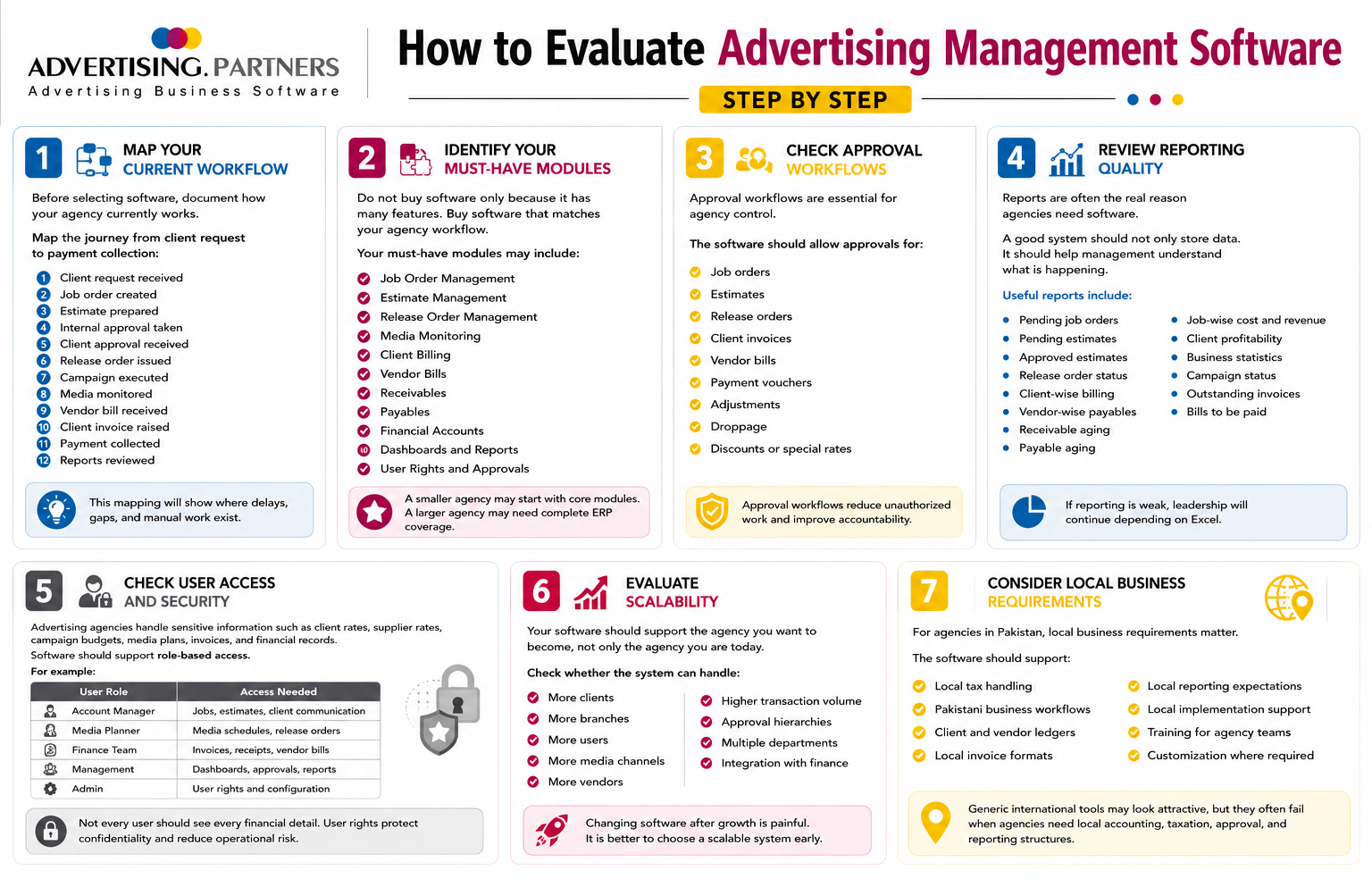
Questions to Ask Before Buying Advertising Management Software
Before choosing a vendor, ask these questions:
- Does the software support job order management?
- Can estimates be created from approved job orders?
- Can release orders be linked with estimates?
- Does it support media monitoring?
- Can it track droppage?
- Can client invoices be generated automatically?
- Can vendor bills be linked with release orders?
- Does it include financial accounts?
- Does it provide receivable and payable aging?
- Can users have role-based access?
- Does it support approval workflows?
- Can management view dashboards?
- Does it support agency-specific reports?
- Is local support available?
- Can the system grow with the agency?
The best software is not always the one with the longest feature list. It is the one that fits your workflow and improves control.
Common Mistakes Agencies Make When Choosing Software
Choosing generic project management tools
Project tools can manage tasks, but they usually cannot manage estimates, release orders, media billing, vendor bills, droppage, and financial accounting.
Ignoring finance integration
If finance remains disconnected, the agency will still struggle with reconciliation.
Buying only for one department
Software should support the full agency workflow, not only account management or finance.
Not involving real users
Account managers, media teams, finance teams, and management should all participate in evaluation.
Underestimating implementation
Even good software fails without proper configuration, training, and workflow discipline.
Focusing only on price
Low-cost software can become expensive if it creates manual work, reporting gaps, or operational confusion.
What Makes Advertising.Partners Different?
Advertising.Partners by Softronic Systems is designed as an ERP for advertising agencies, not just a generic billing or task management tool.
It supports the operational and financial lifecycle of agency work by connecting job orders, estimates, release orders, media monitoring, droppage, invoices, vendor bills, payments, and financial accounts.
The value is not only in automation. The value is in control.
Advertising.Partners helps agencies improve:
- Job order visibility
- Estimate approval discipline
- Release order tracking
- Media monitoring control
- Client invoice accuracy
- Vendor bill management
- Receivable and payable visibility
- Financial reporting
- Management decision-making
For agencies that want structured workflows, better accountability, and stronger financial visibility, an integrated advertising ERP provides a stronger foundation than disconnected tools.
Advertising Management Software Selection Checklist
Use this checklist before making a decision.
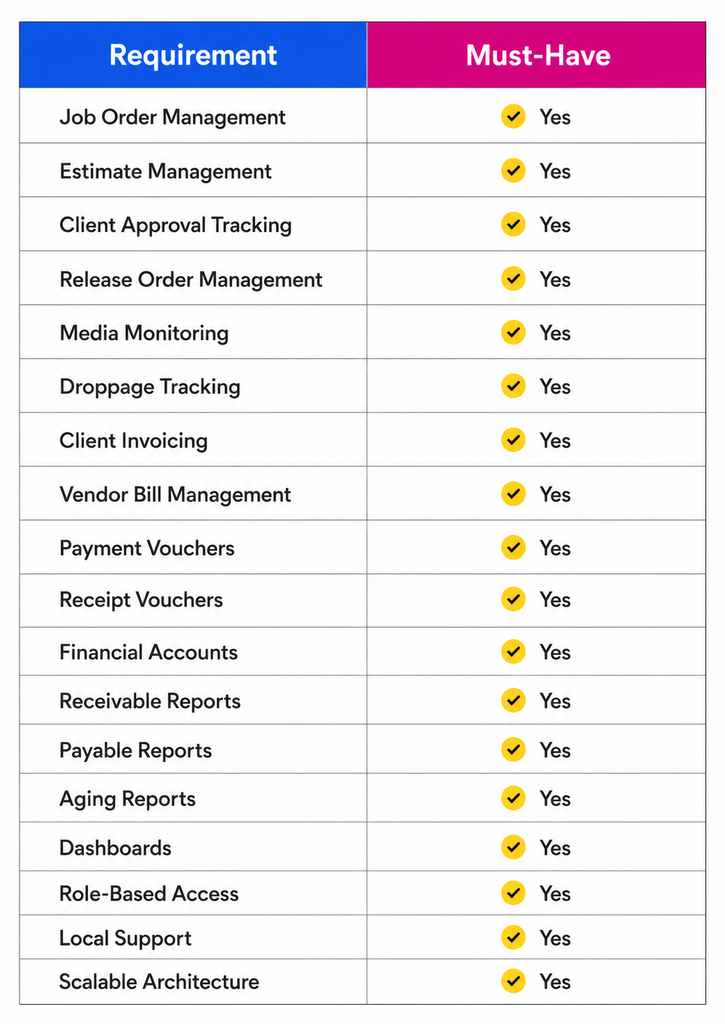
If a system misses several of these areas, it may not be complete enough for a growing advertising agency.
Final Thoughts
Choosing the best advertising management software for your agency requires more than comparing screens, prices, and feature lists.
You need to understand how your agency actually works.
Start with your workflow. Identify where information gets delayed, where approvals are missed, where billing errors happen, where vendor payments become unclear, and where management lacks visibility.
Then choose software that connects the full lifecycle:
Client request → Job order → Estimate → Approval → Release order → Media monitoring → Vendor bill → Client invoice → Payment → Reporting.
This connected flow is what turns software into a real business control system. Advertising.Partners supports this approach by giving advertising agencies a structured ERP platform for operations, finance, approvals, monitoring, and reporting. It helps agencies reduce manual dependency, improve accountability, and manage growth with better visibility.
For agencies in Pakistan that want to move beyond spreadsheets and disconnected systems, Advertising.Partners provides a practical path toward more organized, transparent, and profitable agency management.